
The DIY tools market is undergoing a period of accelerated technical transformation. High-density batteries, embedded sensors, European regulations on product lifespan: the high-tech innovations arriving in the workshops of individuals are no longer limited to power gains. They are reshaping how a tool is designed, used, and recycled.
Wireless tool batteries and European regulations: what is changing concretely
Wireless technology already dominates the consumer tools market. However, it is in regulatory terms that the subject is evolving most rapidly.
The European regulation (EU) 2023/1542 states that from February 18, 2027, any portable battery integrated into a product must be easily removable and replaceable by the end user, with tools available commercially. Drills, impact drivers, workshop vacuums: all power tools sold in Europe are affected.
For manufacturers, this implies a redesign of machine designs. Many recent product lines had shifted towards battery packs that are difficult to disassemble, sometimes glued or integrated into the chassis for compactness. This approach will need to be abandoned in favor of a “battery-replaceable by design” concept.
Field feedback on this point varies: some professionals see it as an ergonomic step backward, while others welcome the possibility of extending a tool’s lifespan by simply replacing its cell without having to buy the entire machine again. For the DIY enthusiast, the direct consequence will be easier access to replacement batteries and, ultimately, a reduction in ownership costs.
Following Bricotronique’s news allows you to spot brands that are already anticipating this obligation in their new ranges.
Connected tools for DIY: beyond the gadget
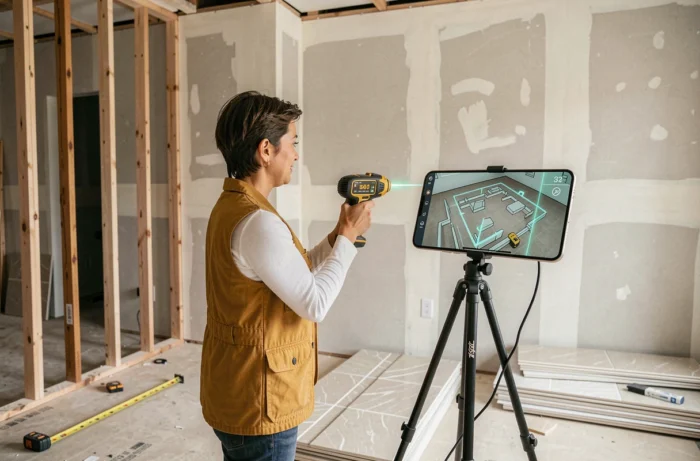
Embedded sensors in tools are no longer reserved for professional sites. Several manufacturers now offer drills and saws whose motors automatically adjust torque or speed based on the detected material. The principle relies on accelerometers and resistance sensors that analyze force feedback in real time.
The concrete benefits for an individual boil down to two points. The first is safety: a tool that reduces its speed when it encounters a knot in wood or a metal framework in concrete limits the risk of kickback. The second is the durability of the accessory: a blade or drill bit used at the right speed wears out less quickly.
Mobile applications and tool tracking
Some brands pair their tools with applications that record usage hours, signal upcoming maintenance, and allow for geolocation of a device in case of theft. Application tracking mainly concerns semi-professional ranges, but it is gradually moving down to entry-level products.
The adoption of these functions by occasional DIYers remains difficult to measure at this stage. Usage seems more established among artisans managing a significant tool inventory.
REP system and eco-design: the hidden side of high-tech tools
Since the official transition to the extended producer responsibility (REP) system for electrical equipment, DIY tool manufacturers must finance the collection and treatment at the end of their products’ life. This constraint directly impacts the design of new tools.
The technical consequences are visible:
- Increased modularity of components: motor, casing, electronics, and battery must be separable to facilitate sorting at waste disposal sites and recycling of materials.
- Reduction of structural adhesives in favor of mechanical fasteners (screws, clips), which also makes repairs more accessible for users.
- Mandatory marking of plastic and metal materials on each part, facilitating identification during disassembly.
This eco-design logic aligns with the “pro accessible” trend observed in the market. A tool whose parts can be easily disassembled is also a tool that an individual can maintain themselves, without resorting to an authorized service center.

Quiet and brushless tools: the motor technology transforming the workshop
Brushless motors are becoming widespread in consumer ranges. Their advantage is not limited to superior energy efficiency, which allows for more work cycles per battery charge.
The absence of brushes eliminates a major source of noise and vibrations. For a DIYer working in an apartment or adjacent garage, the difference is noticeable. Several manufacturers now position noise level as a selling point on par with power.
Current limitations of consumer brushless technology
The additional cost compared to a traditional brushed motor remains significant in entry-level products. However, the mechanical lifespan of a brushless motor is significantly longer, as there are no wear parts in direct contact.
The other limitation concerns reparability. A failing brushless motor often requires replacing the control electronics board, a component whose price represents a significant portion of the tool’s total cost. This is a point to watch in the coming years, especially since the European regulation on batteries could encourage manufacturers to make these electronic modules more accessible.
High-tech DIY is not just about accumulating sensors and connected functions. The most structural evolutions underway, whether related to regulations on replaceable batteries or the REP system, touch on the very design of tools. The DIYer gains in repair autonomy and equipment lifespan, two criteria that weigh as much as raw power at the time of choice.