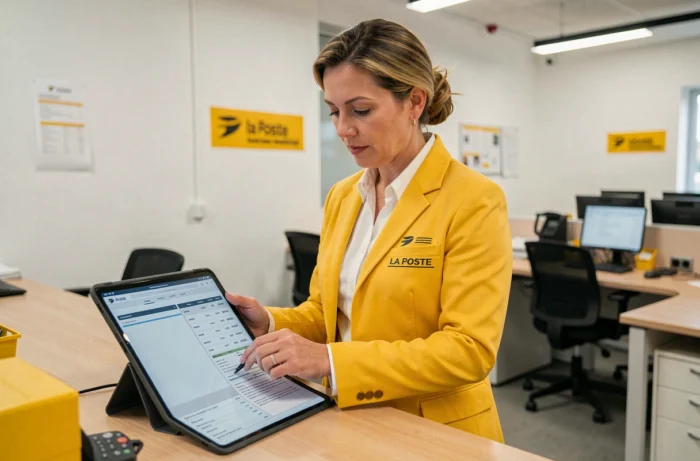
Every year, La Poste provides its employees with workwear suited to their roles, whether they are postal workers, counter staff or logistics personnel. The Monespacehabillement platform centralizes this process, allowing managers to prepare, track and approve clothing allowance orders for their teams.
Behind the interface, the portal raises practical questions about the distinction between branded uniforms and personal protective equipment, responsibilities for garment care, and the limitations of a standardized catalog when faced with the diversity of roles.
Branded uniforms and PPE: a distinction that determines orders on Monespacehabillement
Before even opening the catalog, managers must answer a question that is rarely addressed in user guides: is the garment being ordered intended to represent the company’s image or provide personal protection? The answer determines which legal framework applies.
A polo shirt or jacket in La Poste’s colors, intended to identify an employee to the public, is a company uniform. A garment intended to protect against an occupational hazard is PPE and is subject to stricter requirements. The French Labor Code requires employers to provide it free of charge, cover its maintenance, and replace it as soon as it no longer provides adequate protection.
On Monespacehabillement, this distinction is not always clear in the catalog structure. A unit manager ordering safety shoes for a sorting employee and a high-visibility vest for a postal worker is not handling two equivalent order lines. Caro Fashio News has also explored this topic in detail in an analysis of the managers’ catalog.
For PPE, selections should be based on the occupational risk assessment recorded in the single risk assessment document (DUERP), not just on the product image shown online. A manager who approves a PPE order makes the employer responsible for ensuring that the equipment selected is appropriate for the identified risk.
How team orders are approved on the La Poste platform
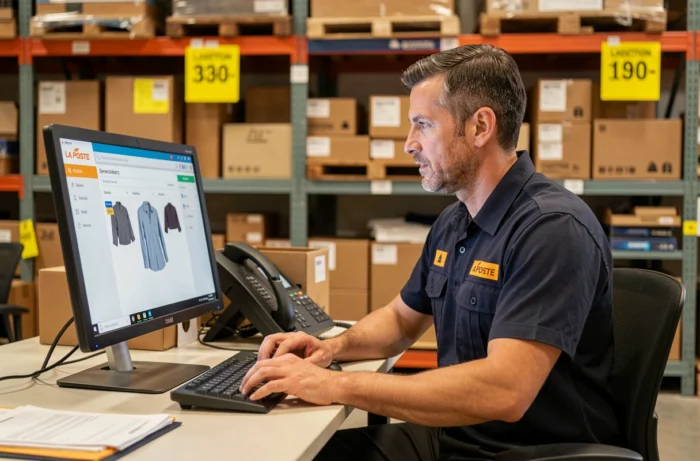
The approval process on Monespacehabillement follows a hierarchical structure. Employees browse the catalog for their clothing allowance, select items in their preferred sizes, and submit their request. Their manager then receives a notification to review and approve (or reject) each line.
What managers actually check
Approval involves more than clicking an approve button. Managers check several points before confirming an order:
- Whether the selected items are appropriate for the employee’s role (a counter clerk has different needs from a postal worker on a delivery route)
- Whether the order is within the unit’s clothing allowance budget, which limits the number of items that can be ordered per cycle
- The condition of the employee’s current equipment, to determine whether an early replacement is justified or the standard allowance is sufficient
Managers approve whether an order is appropriate, not just whether it exists. This screening role explains why the platform requires approval from the line manager before an order can be shipped.
Delivery times and tracking after approval
Once an order is approved, the portal generates a purchase order and sends it to the logistics provider. Delivery tracking is available from the manager’s account, with the status updated at each stage. Delivery times vary by item: standard garments (polo shirts, trousers) are generally available sooner than specialist equipment (safety shoes, technical parkas).
Care and replacement: obligations that go beyond the platform
Monespacehabillement handles initial orders and periodic replacements. But management does not end when the garment is handed over. For PPE, employers must ensure that equipment is maintained and repaired, and replace items that are worn or damaged.
This obligation raises a practical question for unit managers: how can they report that PPE needs replacing outside the regular allowance cycle? The platform allows exceptional requests, but their approval process can take longer than that for standard orders. A postal worker whose safety shoes are damaged midway through a cycle may have to wait several weeks.
Replacing worn PPE should not depend on the clothing allowance schedule, since the French Labor Code ties the replacement requirement to the condition of the equipment, not to a fixed schedule. Managers using Monespacehabillement therefore need to know how to submit an out-of-cycle request to avoid falling short of their obligations.
The limitations of a standardized catalog for La Poste’s diverse roles
The Monespacehabillement catalog covers a wide range of roles, from parcel platform employees to banking advisers at post offices. This standardization makes centralized management easier, but it also creates blind spots.
An employee assigned to a delivery route in a rural mountain area and a city postal worker using an electric bike face very different conditions. The garments on offer are organized by job category, not by local weather or geography. The catalog covers job categories, not conditions in the field.
Sizing is another source of friction. Exchanges for different sizes require additional administrative time from both the employee and the manager, who may sometimes need to reapprove a modified order. Some units have arranged advance fittings using samples, but this remains an informal practice and depends on local initiative.
Accessing Monespacehabillement and resolving login issues
Employees access the portal using their La Poste work credentials. The most common login issues involve password resets and new managers who have not yet been granted access rights.
- A recently promoted manager must ask HR or their establishment’s clothing coordinator to activate their approval rights
- Password resets are handled through La Poste’s centralized authentication portal, not directly through Monespacehabillement
- Employee and manager accounts are separate: users logged in as employees cannot see the approval features
Manager access rights are not activated automatically when someone takes up a new role. This administrative delay can prevent an entire team’s orders from being approved during the first few weeks.
The Monespacehabillement portal streamlines La Poste’s workwear logistics, but its effectiveness depends largely on how well managers know how to use it. Understanding the distinction between branded uniforms and PPE, knowing the out-of-cycle request procedures, and managing access rights are all areas where on-the-ground support can make the difference between a well-used tool and a source of delays.