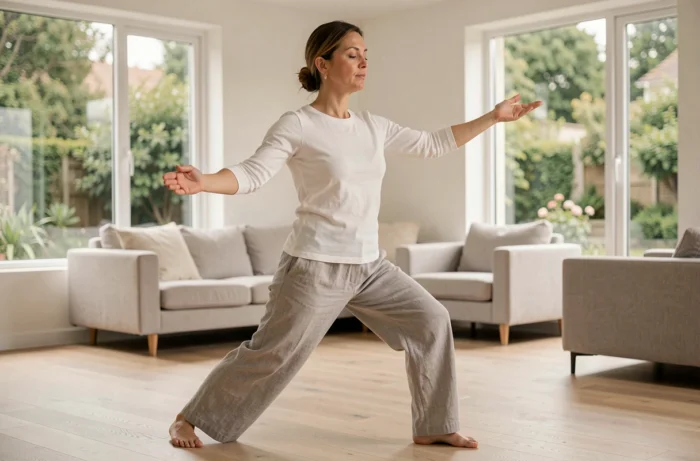
Tai chi is traditionally practised in a group, in a park or studio, under the supervision of an instructor who corrects postures in real time. Practising this discipline at home means compensating for the lack of an outside perspective with a few technical precautions, particularly when it comes to balance and weight distribution.
For beginners, the challenge is not the complexity of the movements, which are naturally slow, but the ability to recognise their own imbalances without visual or tactile feedback from an instructor.
Practising tai chi at home after a fall: adapting your session if your balance is fragile
People who have already fallen or feel unsteady when standing are a particular group. For them, following a general tai chi video without taking precautions means overlooking an important safety factor. The NHS guide recommends seeking advice from a professional after a fall before resuming any balance activity, even a gentle one.
In practical terms, this means that a beginner who feels unsteady should keep a stable support within reach during their first sessions: the back of a chair, a countertop or a wall. The aim is not to hold on constantly, but to have a reassuring point of contact during weight transfers from one foot to the other.
If you want to learn how to practise tai chi in this situation, the first step is to reduce the range of your movements. A shorter step reduces the time spent balancing on one leg, when the risk of losing your balance is highest. Short forms (eight or sixteen movements instead of twenty-four) are better suited to this situation.
When a video is no longer enough
A video cannot detect hip asymmetry, a knee that turns inward or excessive pressure on the ball of the foot. If imbalances persist after several weeks of practice, or if new joint pain develops, individualised supervision becomes necessary. As the NHS points out, preventing falls may require more than exercise alone, including a medical assessment or targeted rehabilitation.
Clinical trials have examined tai chi delivered remotely, but a recent review notes considerable variation in the styles and protocols used, as well as uncertainty about long-term effects and participant adherence. Not all online videos are equally reliable, and none can replace a professional for people at risk.
Posture and weight distribution: the two things to monitor on your own
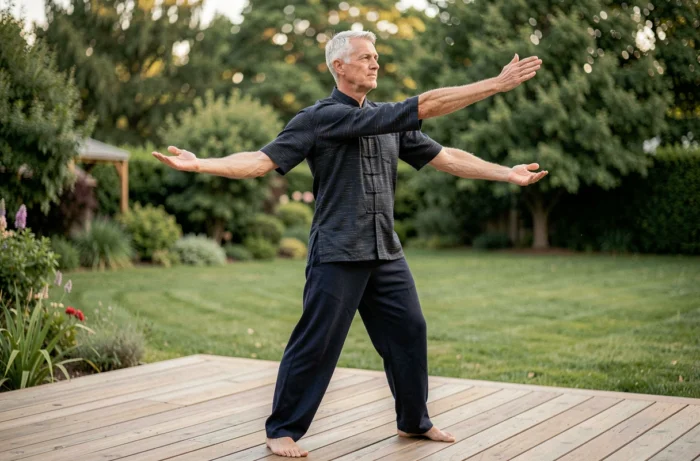
In a group class, the instructor spends most of their time correcting two things: keeping the torso upright and distributing weight between both feet. At home, these become the only reliable criteria for assessing the quality of your own practice.
Keep your torso upright, without leaning forward or arching your back. A simple cue is to imagine a thread pulling the crown of your head towards the ceiling. Let your shoulders drop and your pelvis relax slightly downwards. This basic posture (called “zhàn zhuāng” in some styles) should first be practised while standing still for one to three minutes.
Weight transfer is the second key element. In tai chi walking, the advancing foot is placed down without bearing weight at first, then the weight shifts gradually. Here are some points to check when practising alone:
- Keep the knee of the supporting leg aligned over the foot, without letting it extend past the toes
- In most Yang styles, place the front foot down heel-first before transferring your weight
- Keep your pelvis facing the direction of movement rather than rotating sideways as you shift your weight
Recording yourself from the side with a phone propped on a piece of furniture lets you check these alignments after your session. It is an imperfect substitute for an instructor’s eye, but the most accessible option at home.
Tai chi and strength training: the limits of practising on its own
It would be inaccurate to present tai chi as a complete form of exercise for beginners. Tai chi does not replace conventional strength training, particularly for the upper body and core. Slow movements mainly work the quadriceps, glutes and ankle stabilisers, but the load is low compared with resistance exercises.
For someone starting to exercise at home, combining two or three short tai chi sessions a week with strength training (even light bodyweight exercises) produces better overall results than practising tai chi alone. Chair-assisted squats, calf raises and side leg raises complement tai chi forms well, targeting the same muscle groups at a higher intensity.
Planning your first few weeks of practice
A beginner’s session does not need to last more than ten to fifteen minutes. Tai chi chuan is built through repetition of a small number of movements, not by accumulating new forms. Practising two or three movements correctly for two weeks is more beneficial than rushing through eight.
A useful sign of progress: when you can perform a movement slowly, without losing your balance or looking at the screen, you have mastered it. That is the cue to add the next one.
- Weeks 1 to 3: stand still in the basic posture for two minutes, then repeat a single movement five to ten times on each side
- Weeks 4 to 6: link two movements, adding coordination between your breathing and the movement
- Beyond that: link three to five movements continuously, with enough fluidity to move between forms without pausing
Practising tai chi at home is a worthwhile introduction to the discipline, provided you do not expect more from it than it can offer without supervision. For people who are steady on their feet and have no history of falls, French-language instructional videos are a sufficient resource for the first few months. For others, an assessment by a healthcare professional or qualified instructor is essential for safe practice.