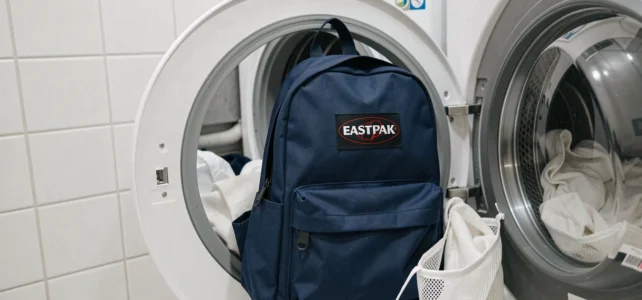
Most Eastpak bags are made from Cordura polyester or nylon, two synthetic fibers that can withstand machine washing as long as a few specific parameters are followed. Machine washing an Eastpak bag does not pose a problem for the mechanical resistance of the fabric, but it can alter the surface treatments applied at the factory, particularly the water-repellent finish.
Water-repellent finish and detergent: what the wash cycle really degrades
Eastpak bags intended for urban use often receive a DWR (Durable Water Repellent) treatment that allows the fabric to repel light rain. This treatment does not withstand the same chemical agents as plain raw polyester.
Standard detergents, fabric softeners, and powders clog the fibers and gradually dissolve this protective layer. The bag comes out clean from the drum, but then it absorbs water instead of repelling it. The effect is often irreversible after two or three washes with an unsuitable product.
To maintain this property, several care guides for technical textiles recommend using a very mild liquid detergent, free from bleaching agents, enzymes, fragrances, and softeners. Products labeled “tech wash” meet these criteria. Alternatively, a diluted liquid Marseille soap in warm water remains a reliable option, found among the most frequently cited tips for washing Eastpak bags.
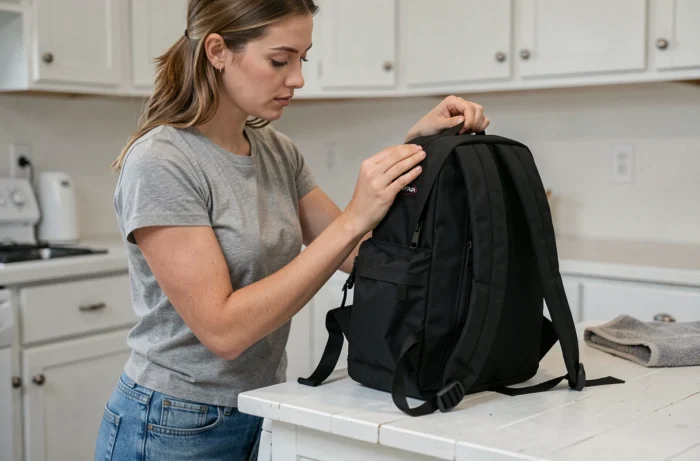
Machine settings for washing an Eastpak bag without damaging it
The program to select depends less on the brand of the bag than on its construction. A classic Eastpak (Padded Pak’r, Out of Office) is a soft bag without a rigid frame, which simplifies things.
Temperature and cycle
A cold wash or 30 °C on a delicate cycle is sufficient to dislodge accumulated dirt. Beyond that, the heat risks deforming the thermally bonded reinforcements on the back and weakening the zippers. The spin cycle should remain slow: a too-fast spin can twist the straps and deform the bag’s structure.
Preparation before the drum
Before starting the machine, a few actions protect the bag and the washing machine:
- Completely empty the bag, including the small inner pockets where crumbs, sand, or coins accumulate that can scratch the drum.
- Close all zippers to prevent them from snagging on the fabric during rotation.
- Turn the bag inside out and place it in a pillowcase or a laundry net. This barrier limits direct friction against the stainless steel of the drum.
- Avoid loading other looped or hooked garments in the same cycle: a metal zipper can scratch the wet Cordura.
Drying the Eastpak bag: why to avoid the tumble dryer
The tumble dryer is the main cause of degradation of a synthetic backpack after washing. The heated air attacks the internal coatings, deforms the heat-sealed seams, and can partially melt the fine polyester straps.
The safest method remains air drying, with the bag turned inside out and open, hung by the straps in the shade. Direct sunlight speeds up drying but can fade dark colors after a few exposures.
On a classic Cordura Eastpak, the fabric dries in a few hours in dry weather. If the back padding remains damp longer, laying the bag flat on a dry towel speeds up absorption without applying heat.
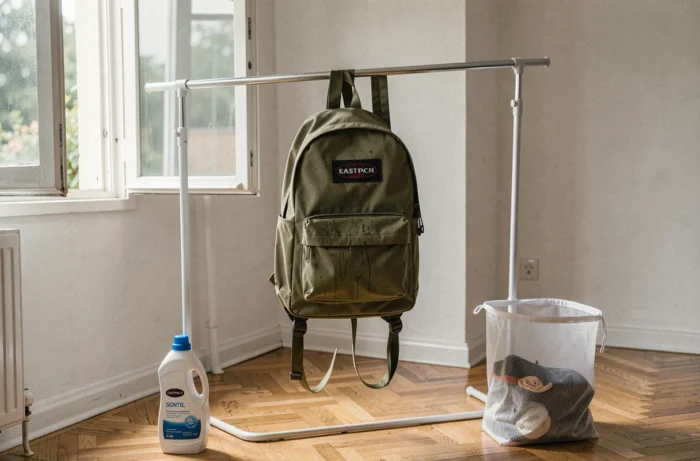
Localized stains on an Eastpak bag: targeted treatment before the machine
Washing a bag in the machine for a single ink or grease stain is often disproportionate. A localized pre-treatment avoids a full cycle and preserves the water-repellency of the rest of the fabric.
For pen stains, a cotton pad soaked in isopropyl alcohol applied by dabbing (not rubbing) dissolves the ink without spreading the pigment. For food grease stains, rubbing dry Marseille soap on the dampened area, letting it act for about ten minutes, then rinsing with warm water, yields good results.
If the stain persists after this treatment, a machine wash with a mild detergent remains the next option. Applying an aggressive chemical stain remover directly on the Cordura can bleach the treated area and leave a halo more visible than the original stain.
Eastpak care label: what it really indicates
The label sewn inside most Eastpak bags mentions cleaning with a damp sponge only. This manufacturer recommendation covers the safest case in terms of warranty, but a gentle machine wash does not damage the Cordura fabric itself.
The nuance is there: Eastpak does not discourage machine washing to protect the fiber, but to protect the surface finishes and glued elements. A user who agrees to reapply a water-repellent spray after washing does not take structural risks with the bag.
Fluor or silicone-based waterproofing sprays, sprayed on the clean and dry bag, reconstitute a hydrophobic barrier comparable to the factory treatment. An application after each machine wash maintains the original level of protection for several years.