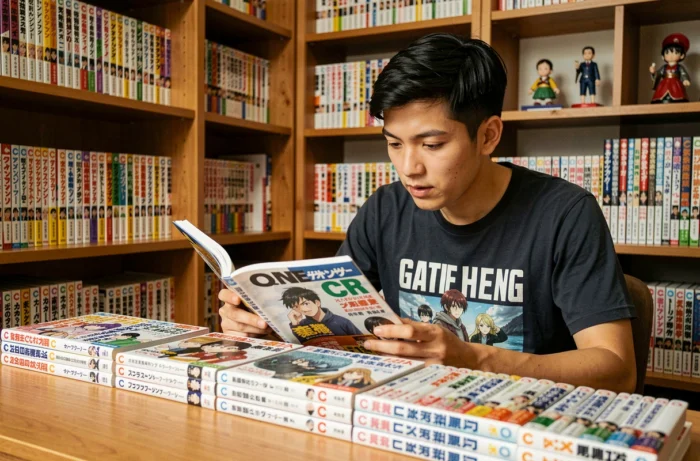
A “C” manga simply refers to a series whose title starts with the letter C. Behind this alphabetical filter lie works of very different registers, from brutal action shonen to psychological seinen, including absurd comedy. Browsing this category allows one to stumble upon major titles that usual rankings by genre or overall popularity do not always highlight.
Why filtering mangas alphabetically changes discovery
Manga rankings almost always work by genre (shonen, seinen, shojo) or by sales volume. This sorting by initial letter breaks this logic and brings together series that would have no reason to coexist otherwise.
Chainsaw Man, Claymore, and City Hunter have neither the same audience, nor the same publication era, nor the same tone. Bringing them together under the letter C forces one to step out of their comfort zone. A reader loyal to combat shonen discovers an urban noir from the 1980s, while a seinen enthusiast stumbles upon a romantic comedy.
This type of navigation is particularly useful for collectors looking to complete a shelf or spot a forgotten title. Browsing the known mangas in C highlights cult series that one easily overlooks when only consulting general rankings.
Chainsaw Man and Claymore: two visions of dark shonen in C
Chainsaw Man, created by Tatsuki Fujimoto, has redistributed the codes of action shonen in recent years. The character Denji, a teenager merged with a chainsaw demon, evolves in a world where devils embody human fears. The story rejects the classic tropes of the genre: no linear power-ups, no speeches about friendship that saves everything. Characters die without warning, alliances fall apart in a single panel.
What distinguishes Chainsaw Man from most shonen is the treatment of violence as a narrative engine rather than mere spectacle. Fujimoto uses gore to reveal Denji’s loneliness, not to embellish fights.

Claymore, by Norihiro Yagi, shares this darkness but anchors it in a medieval-fantasy setting. Half-human, half-monster warriors fight creatures called Yoma. The series, published between 2001 and 2014, has built a coherent universe over time, with a dense mythology that gradually unfolds.
The two titles share a structural commonality: the protagonist is never the most powerful in their own story. This asymmetry of power creates a constant tension that many classic shonen avoid.
What separates them in terms of narrative pace
Chainsaw Man operates through short arcs, almost cinematic in nature. Claymore adopts a slower pace, with arcs spanning several volumes where military strategy takes precedence over individual confrontation. A reader who enjoys quick resolutions will prefer the former. Those who appreciate the patient construction of a world will find more substance in the latter.
City Hunter and Cross Game: two Japanese classics often absent from current selections
City Hunter (Nicky Larson in France), by Tsukasa Hojo, remains one of the most influential action-comedy mangas of the 1980s. Ryô Saeba, a private cleaner in Tokyo, combines sharpshooting skills with sometimes heavy humor. The series defined a model of an ambiguous male character, both protective and caricatural, influencing dozens of subsequent titles.
The manga consists of several dozen volumes and remains popular in Japan, where it has benefited from new adaptations. Its uniqueness lies in the balance between standalone episodes (protection or investigation missions) and a darker background related to the hero’s past.
Cross Game, by Mitsuru Adachi, occupies an entirely different register. It is a baseball manga coupled with a romantic story, published between 2005 and 2010. Adachi is known for telling sports stories without ever making them the true subject: the matches serve as a backdrop for character relationships, grief, and silences.
- City Hunter: urban action, adult humor, 1980s Tokyo, often independent episodes
- Cross Game: sport and romance, subtle narration, contemplative pace, strong emotional charge from the first volume
- Claymore: medieval dark fantasy, hybrid warriors, progressive mythology over more than twenty volumes
- Chainsaw Man: contemporary shonen, horror and absurdity, short arcs, frequent narrative breaks
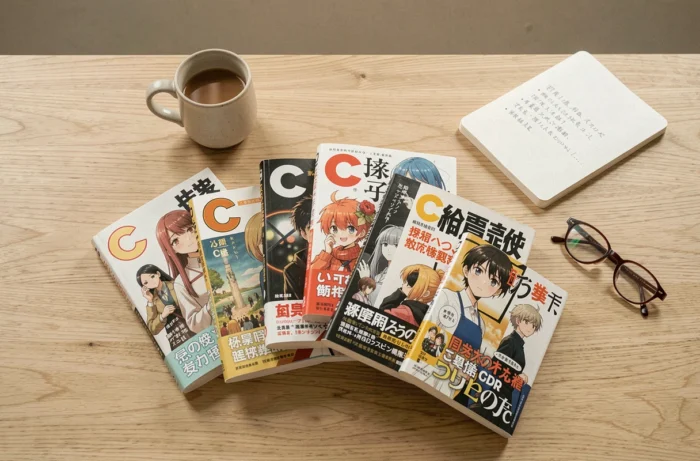
Less publicized C mangas: three titles to watch
Beyond the most visible series, the letter C houses works that deserve attention. Cells at Work (Hataraku Saibou) transforms the human body into a battlefield where white blood cells and platelets are fully-fledged characters. The manga is particularly used in some educational contexts in Japan to popularize biology.
Chi, a Cat’s Life, by Konami Kanata, targets a younger audience with an unusual color format for a manga. The daily life of a kitten adopted by a family serves as a pretext for remarkably expressive panels, far from the sentimentality that the pitch might suggest.
On the seinen side, Cesare by Fuyumi Soryo dives into the Italian Renaissance through the journey of Cesare Borgia, a student at the University of Pisa. The historical research behind each volume is thorough, with faithful architectural settings and documented political intrigues.
How to choose based on your reader profile
A reader drawn to pure action and tonal shifts will turn to Chainsaw Man. Those looking for a manga to read with a teenager will find Cells at Work a good entry point. For a long and immersive read, Claymore or City Hunter each offer several dozen volumes. Cross Game and Cesare, being shorter, suit those who prefer complete stories without a commitment to years of publication.
The French manga market remains the second largest in the world after Japan, even though sales have declined after the post-Covid peak. In this context, exploring catalogs by initial letter rather than current trends allows for the rediscovery of series that the rapid rotation of new releases in bookstores tends to make disappear from the shelves.