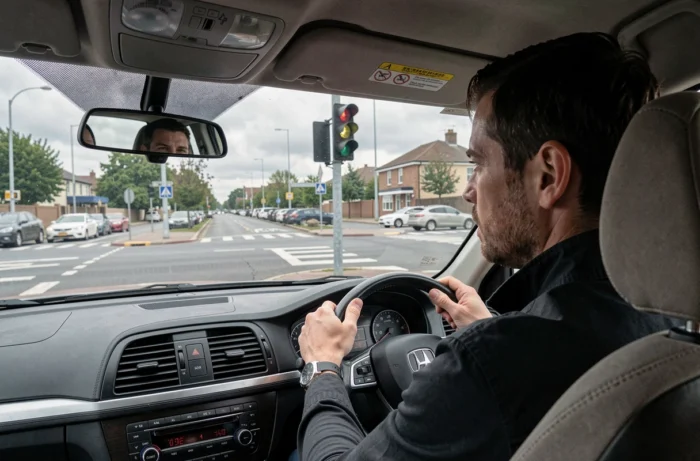
A malfunctioning traffic light or one stuck on a flashing orange changes a regulated intersection into an ordinary crossroads. The Highway Code provides a specific fallback mechanism: non-lighted signage takes over, and in its absence, general priority rules apply. Understanding this hierarchy avoids confusion and the dangerous behaviors that this type of malfunction systematically generates.
Signage Hierarchy: What Replaces a Malfunctioning Traffic Light
The most common reflex is to treat a malfunctioning light as a simple call for caution, without a precise rule. This is a mistake. The regulatory framework, reinforced by the decree of November 24, 1967, on road signage (the consolidated version 2025 has been updated by Cerema), establishes a strict hierarchy between different types of signage.
When a traffic light stops functioning, the priority of command follows this order:
- The instructions of a police officer or an authorized agent to regulate traffic, which take precedence over any other signal.
- The non-lighted signage fixed on the pole of the light, usually a priority sign (stop, yield, priority road) installed to compensate for malfunctions.
- In the complete absence of a sign, the right-hand priority rule becomes the default norm at the intersection.
Therefore, one must look up. Many drivers are unaware that a signage panel is often fixed on the same support as the light. This panel has no effect when the light is functioning, but it regains its full legal value as soon as the malfunction occurs. A stop sign attached below an extinguished light requires a complete stop, just like at any intersection equipped with this sign.
Knowing the procedure in case of a malfunctioning traffic light allows one to anticipate these situations without hesitation in the middle of the intersection.
Flashing Orange Light: Meaning and Appropriate Behavior
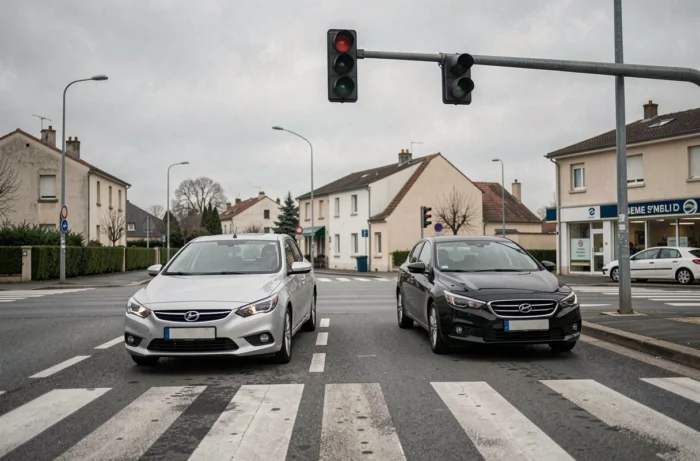
A malfunctioning traffic light does not always remain off. In most cases, the device automatically switches to a flashing orange light. This degraded mode of operation has its own regulatory meaning, distinct from the standard fixed orange light.
The fixed orange light indicates the imminence of red and requires stopping if the vehicle can do so safely. The flashing orange light, however, signals a temporary danger requiring heightened vigilance. It does not order a stop or passage: it transfers the responsibility of assessment to the driver.
Specifically, when faced with a flashing orange light, the driver must slow down, check for the presence of a priority sign on the right pole, and apply the corresponding rule. Without a sign, the right-hand priority applies. A common mistake is to interpret the flashing light as a degraded green light allowing for quick passage. This interpretation leads to side collisions, the most common type of accident at malfunctioning intersections.
Malfunctions Related to Construction Sites: A Distinct Scenario
Not all traffic light malfunctions result from spontaneous technical failures. Roadworks represent a frequent cause of interruption, and the regulatory treatment differs significantly.
When a malfunction occurs in a construction context, temporary construction lights may replace the usual signage to manage alternating traffic. These temporary signage devices are subject to specific technical compliance and positioning requirements. Their presence modifies the applicable priority regime: the driver must then obey the temporary light, not the fixed signs at the intersection.
This distinction is important in the event of an accident. If a construction light is in place, the responsibility for traffic management lies with the construction company and the road manager, not with the driver who follows the displayed indications. However, if the construction light itself is malfunctioning (which can happen), the return to fixed signs and then to right-hand priority applies again.
Recognizing a Malfunctioning Construction Light
A malfunctioning construction light generally remains off, without switching to a flashing orange. The visual difference from a permanently off light is its mobile support (tripod, trailer). In front of this type of extinguished equipment, caution dictates treating the intersection as unregulated and proceeding cautiously.

Reporting the Malfunction: Who and How
A malfunctioning traffic light does not resolve itself. The town hall or the road manager is the competent contact to trigger a repair intervention. On a departmental or national road, it is the departmental council or the interdepartmental road directorate that manages the equipment.
The report can be made by phone to the municipal technical services, or through the online reporting platforms offered by many municipalities. Some urban areas have dedicated applications for road incidents.
Three pieces of information expedite the processing of the request:
- The precise location of the intersection (street names, intersection number if visible on the pole).
- The nature of the malfunction (light off, permanent flashing orange, abnormal color alternation).
- The presence or absence of emergency signage on the light support.
This quick reporting has a direct effect on safety. An unreported malfunctioning light can remain out of service for several hours, even days on secondary roads, multiplying dangerous situations for users who are unfamiliar with the intersection.
Driver Responsibility and Risk of Violation
Failing to respect a stop or yield sign visible under an extinguished light exposes one to the same penalties as at a regular intersection. The malfunction of the light does not suspend the validity of the sign. Crossing a stop without making a complete stop remains subject to a fourth-class fine.
In the absence of a sign, the right-hand priority applies. A driver who cuts off a vehicle coming from their right at an intersection with extinguished lights commits an infraction of the Highway Code and incurs civil liability in the event of a collision.
The flashing orange light, for its part, does not require a stop but commands a slowdown. Passing through an intersection at excessive speed when signaled by a flashing orange can be reclassified as dangerous driving if an accident occurs, with consequences for the sharing of responsibility between the parties involved.
A malfunctioning traffic light remains a common event that every driver will encounter multiple times. The fallback mechanism provided by the regulations works, provided one knows how to read the emergency signage and apply the right-hand priority when nothing else regulates the intersection.