A Bluetooth car beacon is a small device that emits a low-energy radio signal (BLE) picked up by nearby smartphones. It does not calculate its own position: it is the phones in the community network (Apple Find My or Google Find Hub) that relay its coordinates to the owner. This technical distinction conditions everything one can expect, or not, from such an accessory fixed in a vehicle.
BLE Signal and Community Network: What Produces the Location
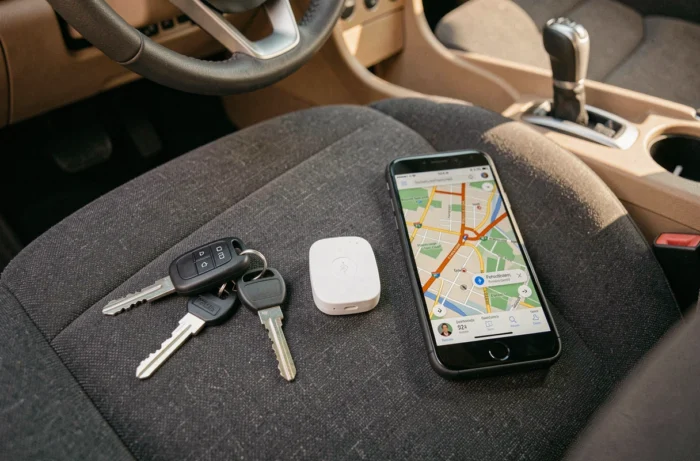
The operation relies on an indirect chain. The beacon broadcasts a Bluetooth identifier at regular intervals, over a range of several dozen meters. When a compatible device passes nearby, it picks up this signal, associates its own GPS coordinates, and transmits the whole, encrypted, to the cloud of the network.
The owner then consults the associated application to see the last known position. The displayed location thus corresponds to the last passage of a participating phone near the beacon, not to a real-time reading.
This mechanism implies a direct dependence on the density of participating devices in the area. In the city center, where compatible smartphones are numerous, the position refreshes frequently. In an isolated parking lot, a country road, or a sparsely populated industrial area, the last known position may date back several hours. As City Automobiles advises, this limitation is structural and does not depend on the quality of the beacon itself.
Bluetooth Beacon vs GPS Tracker: Two Logic of Location for a Car
A built-in GPS tracker works differently. It contains a satellite receiver that calculates its own position and then transmits it via the mobile network (integrated SIM card or eSIM). The location is autonomous: it does not depend on nearby phones.
This autonomy comes at a cost. A GPS tracker typically requires a monthly subscription for cellular data transmission. Its energy consumption is also significantly higher, which necessitates either a connection to the vehicle’s battery or regular recharges.
The Bluetooth beacon, on the other hand, runs on a button cell for several months without intervention. It requires no subscription. Its purchase price is also much lower than that of a connected GPS tracker.
- Bluetooth Beacon: indirect location via community network, no subscription, long battery life, position dependent on the passage of nearby smartphones.
- GPS Tracker with SIM Card: autonomous location via satellite and mobile network, subscription required, high energy consumption, continuously or nearly continuously updated position.
- GPS Tracker without SIM Card: records positions in internal memory, data accessible only through direct connection (Bluetooth or Wi-Fi), no real-time remote tracking.
Anti-Tracking Alerts: A Recent Constraint That Changes the Game
Since the implementation of interoperable alerts between iOS and Android, a phone automatically signals an unknown beacon that moves with its bearer. This protection aims to prevent tracking of individuals without their knowledge.
For a car owner, the consequence is direct. If the vehicle is stolen and a Bluetooth beacon is hidden inside, the thief may receive a notification on their own phone informing them that a location accessory is traveling with them. They simply need to look for the beacon and remove it.
This mechanism significantly reduces the anti-theft effectiveness of a Bluetooth beacon. A discreet GPS tracker, wired into the vehicle’s electrical system, does not emit a detectable Bluetooth signal in the same way and escapes these standardized alerts.
Network Compatibility: A Point to Check Before Purchase
Not all Bluetooth beacons work with all phones. Compatibility with a location network is a criterion distinct from simple Bluetooth connectivity. An AirTag works exclusively with the Apple Find My network. Other beacons rely on Google Find Hub and are only usable from a compatible Android device.
Before purchasing, it is essential to explicitly check which network the beacon uses and whether the owner’s phone participates in it. Buying a beacon linked to a different ecosystem than one’s own amounts to acquiring an inert object.
The Case of Multi-System Households
In a household where iPhone and Android coexist, a single beacon will not cover both users in the same way. The primary owner must be the one whose phone is compatible with the beacon’s network. The other user will not have access to the location unless manually shared via the dedicated application, when this option exists.
Concrete Use Cases Where the Bluetooth Beacon Suffices
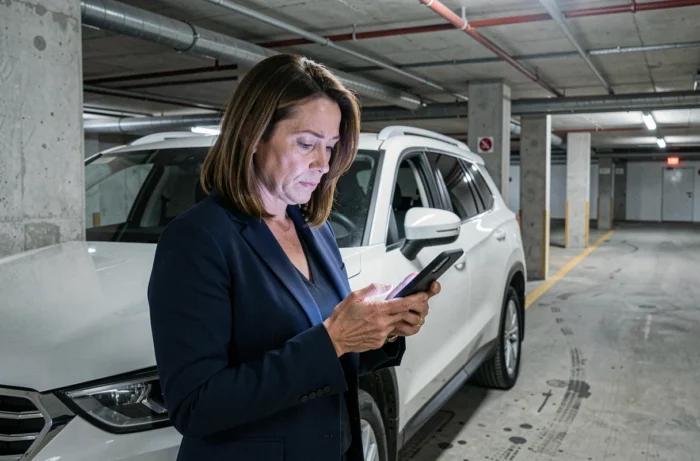
To find one’s car in a large covered parking lot or in the city center, a Bluetooth beacon perfectly fulfills its role. The density of smartphones there is sufficient for frequent position updates, and proximity search (sound signal, directional indication) helps guide the owner in the last meters.
It is also suitable for monitoring a vehicle parked in a dense residential area, for example, to check that it has not been moved without authorization. The Bluetooth beacon is a tracking tool, not an anti-theft security device.
On the other hand, for a vehicle regularly parked in a rural area, for real-time tracking, or for genuine theft protection, a GPS tracker with cellular transmission remains the only reliable option. Anti-tracking alerts and dependence on the community network make the Bluetooth beacon a complement, not a substitute.
The choice boils down to a question of real need: easily finding one’s vehicle daily, or actively protecting it against theft. A Bluetooth beacon costing a few dozen euros meets the first case. For the second, it only slightly delays the discovery of a problem that only a connected GPS tracker can continuously address.