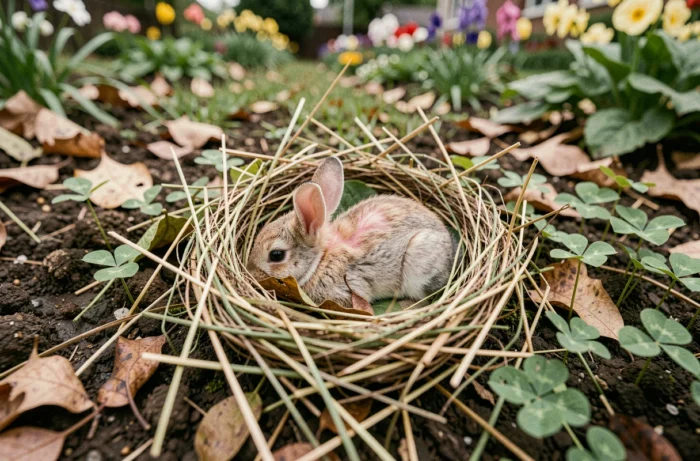
A baby rabbit motionless in the grass, its eyes barely open, with no adult visible around: the scene prompts intervention. Most of the time, this baby rabbit is not abandoned. Wild rabbits (and domestic rabbits returned to a semi-wild state) only visit their nest once or twice a day, usually at dawn and dusk, for a feeding that lasts barely a few minutes. Understanding this maternal behavior radically changes the course of action.
Maternal behavior of the rabbit: why the nest seems empty
The rabbit intentionally limits its presence at the nest to avoid attracting predators. Its visits are brief and often nocturnal, which explains why a human observer almost never encounters it on site.
The rabbit nest is generally a slight depression in the ground, lined with dry grass and fur pulled from the mother’s belly. It can be located in the middle of a lawn, in a flower bed, or at the foot of a hedge. Its rudimentary appearance reinforces the impression of abandonment, whereas it is the normal breeding mode of the wild rabbit as well as some free-ranging domestic breeds.
Baby rabbits are born hairless and blind. During the first two weeks, they remain huddled in the nest without moving. A solitary and motionless baby rabbit in the garden does not necessarily call for help: this immobility is a survival reflex, not a sign of distress. To verify that the X Anima advice for baby rabbits confirms this, the mother returns to feed her young as long as the nest is not disturbed.
String or flour test: checking the mother’s return
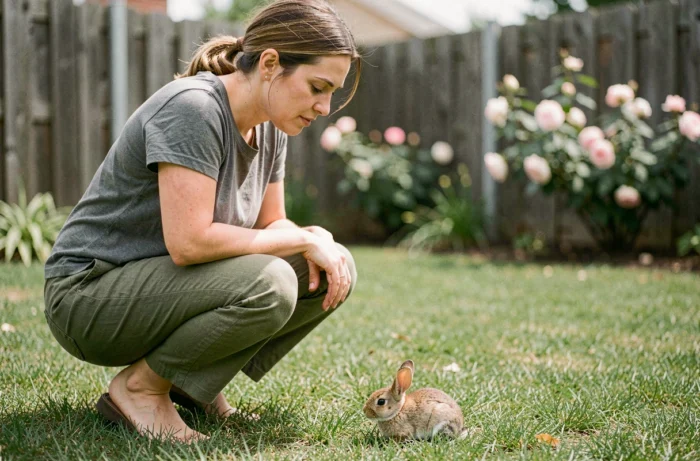
Before any intervention, a simple method allows you to know if the rabbit returns to feed its litter. It involves placing a discreet marker above the nest, then observing if it has been moved.
- Place two strands of string or fine wool in a cross shape above the nest, without touching the baby rabbits.
- Another option: sprinkle a circle of flour around the nest for a few centimeters.
- Check the setup after two consecutive nights: if the string is moved or the flour disturbed, the mother has passed by.
If the setup remains intact after two nights, the likelihood of actual abandonment increases. It is at this stage, and not before, that contact with a professional is warranted.
During this observation phase, keep dogs and cats away from the perimeter. A simple overturned crate, weighted down with a stone and with a sufficient opening for the rabbit, protects the nest without preventing the mother from accessing it.
Feeding baby rabbits: what not to give
The common reflex when faced with an apparently hungry baby rabbit is to offer it milk. This is the most dangerous mistake. Rabbit milk is exceptionally rich in fats and proteins, with a composition that cow’s milk, goat’s milk, or human infant formulas do not replicate at all.
A wild baby rabbit fed with an unsuitable substitute quickly develops fatal digestive disorders. The mortality rate is extremely high in these cases. The current ground rule of care centers is clear: nothing by mouth, even if the animal appears thin or dehydrated.
This guideline also applies to water. A dehydrated baby rabbit needs veterinary care, not an improvised bottle at home. Good intentions kill more wild baby rabbits than predation in these situations.
Injured or confirmed orphaned baby rabbit: who to contact
If the string test confirms the absence of maternal return, or if the baby rabbit shows visible injuries (open wound, deformed limbs, traces of blood), the observation time is over.
The first reflex is to contact a veterinarian or an animal rescue service. These professionals can assess the severity of the situation and arrange transport to a wildlife care center. In France, keeping a wild animal is prohibited without permission: keeping a baby rabbit at home, even temporarily, exposes you to legal complications and reduces its chances of survival.
- Call a nearby veterinarian, who can stabilize the animal or refer it to an approved care center.
- Contact the fire department (18 or 112), which has protocols for wildlife.
- Consult the network of care centers in your department (contact details available from the French Office for Biodiversity).
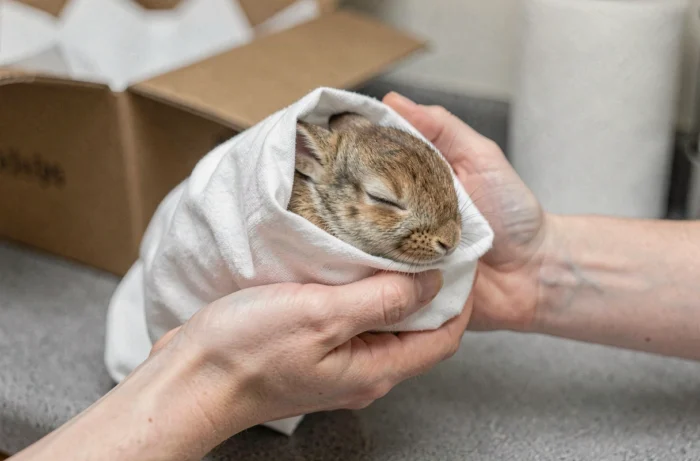
While waiting for intervention, place the baby rabbit in a box with holes, on a soft cloth, in a calm and temperate location. Do not handle it more than necessary. Stress is a significant mortality factor for young lagomorphs.
Protecting rabbit nests in an inhabited garden
Coexistence with a litter of baby rabbits rarely lasts more than three weeks. The young leave the nest as soon as they reach a sufficient size to feed themselves, usually when their fur is complete and they can stand confidently.
During this period, postponing the mowing of the affected area is sufficient in most cases. Lawn mowers and robotic mowers are the leading cause of injuries to nests in urban and suburban areas. Marking the location of the nest with a small visible stake prevents accidents during distracted passes.
Limiting access of pets to the nest area remains the most effective measure. A curious dog does not necessarily want to attack, but its scent and agitation can cause the rabbit to abandon its litter for good.
A baby rabbit found in a garden is almost always a baby rabbit in safety. Two nights of patience and a cross string are enough to confirm its status, without any human intervention being necessary.