
The size M for women theoretically corresponds to a French 38, but this equivalence hides real disparities depending on the brands, cuts, and current trends. Understanding what this unique letter encompasses requires looking beyond the simple size chart, as the measurements associated with M can vary by several centimeters from one brand to another.
Why M for women does not designate a single measurement
The letter size system (XS, S, M, L, XL) does not adhere to any binding standard in France. Each brand defines its own measurement ranges for the same letter.
The result: an M at O’Neill corresponds to a bust measurement of 90 to 94 cm and a waist measurement of 70 to 74 cm, while other brands display significantly different ranges for the same letter.
A difference of several centimeters in bust measurement between two brands is enough to shift a woman from M to L, or conversely from S to M. Knowing what size corresponds to M for women therefore requires consulting the size guide specific to each manufacturer rather than relying on a generic equivalence.
The recent evolution of cuts amplifies the problem. For several seasons, the oversized trend has led brands to cut more generously on certain pieces. A woman who wore a fitted M a few years ago may now hesitate between S and M depending on whether she chooses a fitted cut or a looser volume. An M in 2026 is often designed to be worn slightly loose rather than tight.
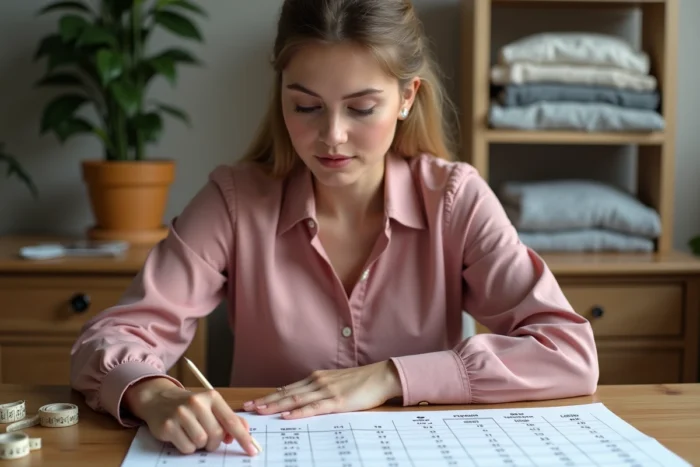
Size M for women: French and international correspondences
The most common equivalence associates M with French size 38. Data collected from several brand guides confirm this basis, with nuances depending on the type of clothing.
Correspondence for women’s tops
| International Size | French Size | Bust Measurement (cm) | Waist Measurement (cm) |
|---|---|---|---|
| S | 36 | 82-86 | 62-66 |
| M | 38 | 86-94 | 66-74 |
| L | 40 | 90-99 | 70-79 |
The wide ranges in the M column reflect the discrepancies between brands. For a top, bust measurement remains the determining factor: it is the first to be taken with a measuring tape, at the fullest part, without tightening.
Correspondence for women’s bottoms
| International Size | French Size | Waist Measurement (cm) | Hip Measurement (cm) |
|---|---|---|---|
| S | 36 | 62-66 | 88-92 |
| M | 38 | 66-74 | 92-100 |
| L | 40 | 70-78 | 96-105 |
For pants, skirts, or dresses, hip measurement takes precedence over waist measurement. It is taken at the widest part of the hips. If your measurements fall between two sizes, the most common recommendation among manufacturers is to choose the larger size.
Taking measurements to choose size M
Measuring correctly avoids most sizing errors, whether the purchase is made online or in-store. Three measurements are sufficient for regular clothing.
- Bust measurement: place the measuring tape horizontally, at the fullest part of the bust, arms at your sides, without compressing
- Waist measurement: measure at the narrowest part of the torso, generally above the navel, while breathing normally
- Hip measurement: measure at the widest part of the buttocks and hips, with feet together
Height also plays a role for dresses and jumpsuits. Some brands offer “petite” or “long” variations within the same size M, adjusting the length of the bodice and inseam.

Common pitfalls when shopping online
Buying clothes without trying them on exposes one to disappointments that size charts do not always resolve. Several concrete factors explain returns.
The fabric type alters the fit of the same size. An M in woven cotton does not offer the same ease as an M in stretchy jersey. Brands do not systematically adjust their patterns based on the elasticity of the fabric, which creates comfort discrepancies at identical measurements.
Field returns also differ on the issue of body shape. Two women with the same bust measurement can have very different builds, torso lengths, or volume distributions. M may fit one on top and not the other, without the raw measurements explaining it.
- Check the brand-specific size guide before each purchase, even for a brand already known (patterns change from one collection to another)
- Compare your measurements in centimeters to the indicated ranges rather than relying on your “usual size”
- Read customer reviews that mention body shape or fit (“runs large,” “runs small,” “fitted cut”)
The environmental labeling that is gradually being implemented on textiles sold in France adds an additional data point on labels. This labeling system, now formally adopted, concerns all producers, importers, and distributors of textiles in the French market. It does not directly change the choice of size, but it encourages some brands to streamline their size charts to limit returns and their logistical impact.
A well-chosen garment in the right size is also a garment that is kept. Taking thirty seconds to measure yourself with a measuring tape before ordering remains the most reliable action, regardless of the displayed size system.