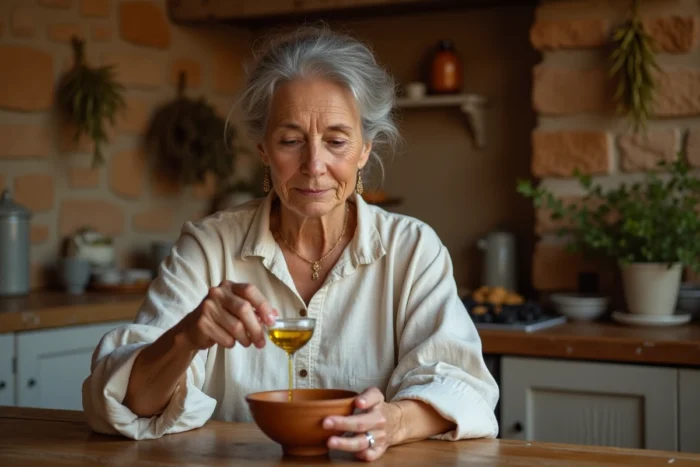
The test of the evil eye with olive oil is based on a simple principle: observing the behavior of drops of oil placed on the surface of a container of water. According to Mediterranean traditions, the way the oil disperses or remains on the surface allows for the identification of negative energies. This practice, passed down orally for generations, remains vibrant in Corsica, Southern Italy, Greece, and several Maghreb countries.
Why olive oil and not another fat
Olive oil occupies a central place in protection rituals because it carries a symbolic weight that other oils do not have. In Christian traditions, olive oil is used for anointing the sick and for baptism. In Islam, the olive tree is mentioned in the Quran as a blessed tree. This dual sacredness explains why rituals against the evil eye favor this fat over a neutral vegetable oil.
On a physical level, extra virgin olive oil has a stable density that produces round and well-formed drops on the surface of the water. A refined or blended oil behaves differently, which can distort the reading of the test. Traditional practitioners emphasize the choice of a quality oil, unfiltered if possible, so that the ritual is legible.
Those looking to remove the evil eye with olive oil will find in this physical property the technical reason for choosing olive: a drop that remains perfectly round indicates, according to tradition, the absence of disturbance.
Olive oil ritual in water: detailed method
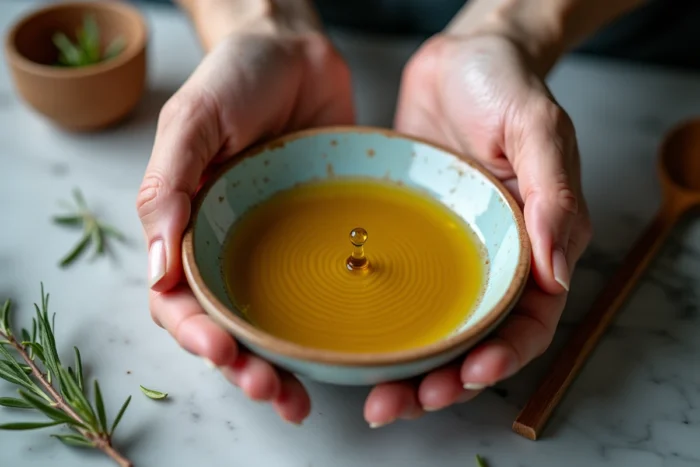
The traditional ritual requires only three elements: a container filled with clear water, extra virgin olive oil, and an intention formulated aloud or in silence. The person performing the test is generally not the one being tested.
- Fill a shallow plate or a white bowl with cold water, preferably untreated (spring water or filtered water).
- Dip a finger (the index or middle finger) into the olive oil, then let three drops fall onto the surface of the water, one by one.
- Observe the drops for about thirty seconds without moving the container or blowing on it.
If the drops remain round and distinct, traditional reading considers that there is no evil eye. If they spread, merge with each other, or sink to the bottom, the test is considered positive.
Some regional variants add a prayer. In Corsica, the signadori recite secret formulas passed down only from mother to daughter, often on Christmas Eve. In Southern Italy, the formula is sometimes accompanied by a sign of the cross traced above the container. The ritual is always performed without financial compensation in the authentic tradition.
Removing the evil eye: purification after a positive test
A positive test (drops that disperse) calls for a second ritual, this time oriented towards purification. Several approaches coexist according to cultural and religious traditions.
In Christian Mediterranean traditions, the most common method is to throw the test water at a crossroads or into a stream, then repeat the ritual three times in a row. If the drops regain their round shape on the third attempt, the evil eye is considered lifted.
In Islamic tradition, roqya is the recommended approach. It relies on the recitation of verses from the Quran, notably Al-Fatiha and the last three surahs (Al-Ikhlas, Al-Falaq, An-Nas). Olive oil can be used as a medium: the verses are recited over the oil, which is then applied to the body. The roqya does not involve any intermediary between the believer and Allah.
Salt is another element frequently associated with purification. Placing coarse salt in the corners of a room for several days, then throwing it away without touching it with bare hands, is part of the protective gestures complementary to the oil ritual.

Limits of the ritual and risks of abuses
The growing interest in cleansing rituals has a downside. The mainstream press, including L’Express, has recently warned about the proliferation of booklets and practitioners who commercialize these practices, sometimes with promises of healing. A protection ritual never replaces medical or psychological follow-up.
Persistent fatigue, insomnia, or a feeling of repeated bad luck may have identifiable physiological or psychological causes. The olive oil test belongs to the realm of cultural tradition and personal belief, not to that of diagnosis.
The French legal framework, stemming from the 1905 law on the separation of churches and state, guarantees freedom of conscience and the free exercise of spiritual practices, provided they respect public order. Anyone who demands payment to “lift the evil eye” steps outside the traditional framework and exposes themselves to prosecution for abuse of weakness.
- Beware of anyone who asks for money to perform a protection ritual.
- Never interrupt medical treatment in favor of a spiritual ritual.
- Favor practices passed down in a family or community setting, without commercial intermediaries.
Corsican signadori, Calabrian grandmothers, or roqya reciters share a common point: the gratuity of the gesture is an integral part of the tradition. As soon as a fee appears, the ritual loses its cultural coherence and its grounding in the oral transmission that has founded it for centuries.