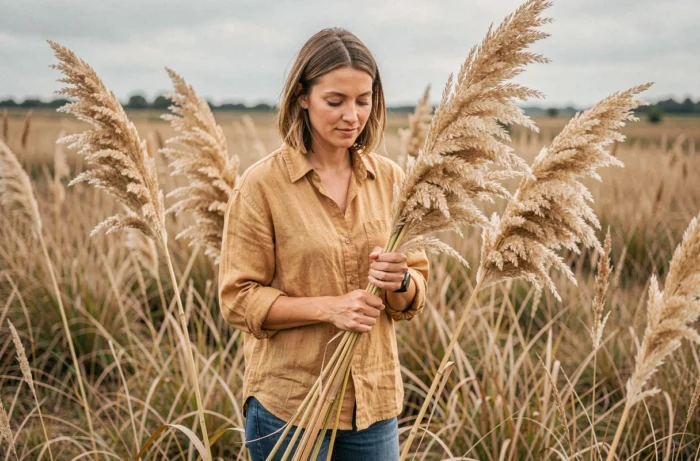
Cortaderia selloana has been on the French list of regulated invasive exotic species since 2023. Picking pampas grass for free along roadsides or wastelands is still possible, but under specific legal and botanical conditions that most foraging guides overlook.
Regulations on Cortaderia selloana: what the law really prohibits
The ministerial decree of February 14, 2018, amended in 2023, prohibits in mainland France the possession, transport, donation, exchange, and sale of live specimens of Cortaderia selloana. A fresh flower spike containing viable seeds falls into this category.
However, a stem that is already dry, with non-viable seeds, is not subject to the same regulations. We recommend only harvesting clearly dried plumes, with seeds dispersed for several weeks. The distinction between a dry spike and one that is still fertile is the technical point to master before any foraging trip.
To know where to pick pampas grass for free without legal risk, you must also check the land ownership status: a national park, nature reserve, or Natura 2000 site may prohibit any plant harvesting, even of a non-protected species.
Protected areas and prohibited foraging
In national parks and nature reserves, the collection of plants is subject to the site’s internal regulations. Even if Cortaderia selloana is considered undesirable there, the manager may refuse any harvesting by individuals. A call to the town hall or the local tourist office is enough to clarify any doubts.
On private land, the owner’s permission is mandatory. On communal land (roadside, embankments, municipal wasteland), the mayor can authorize or prohibit foraging by decree. No address is universally “free of rights.”
Foraging period and maturity stage of the plumes
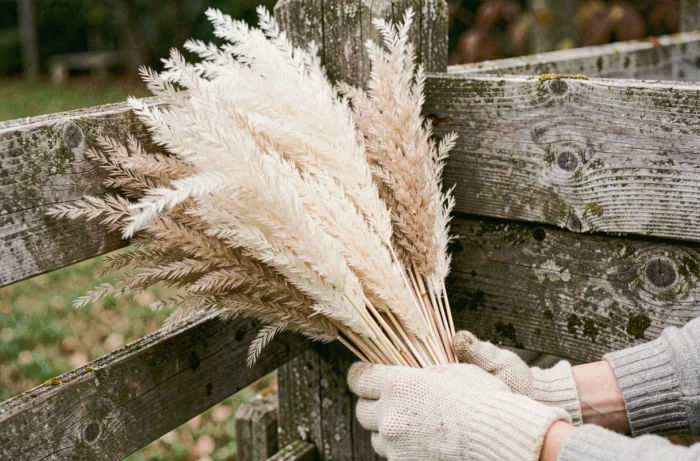
The suitable window is between late October and December, when the inflorescences have turned white and begun to dehydrate naturally on the plant. At this stage, the seeds have already been dispersed by the wind, which reduces both the legal risk and the risk of unintentional dissemination during transport.
Foraging in September, at the peak of flowering, poses two problems. The plume is still loaded with viable seeds, which puts you at potential risk of infringement. And the stem, full of sap, will dry poorly: the plumes retract, turn brown, and lose their volume.
Recognizing a spike ready to be harvested
- The plume is cream white to beige, never greenish or purplish. A silvery sheen indicates advanced maturity.
- By gently shaking the stem, no rain of fine seeds falls. If seeds fly off, the spike is still fertile.
- The stem is rigid and brittle at the base, not flexible. A still green or flexible stem contains sap and viable seeds.
This field test takes a few seconds and distinguishes responsible harvesting from problematic collection.
Location of pampas grass in France: favorable environments
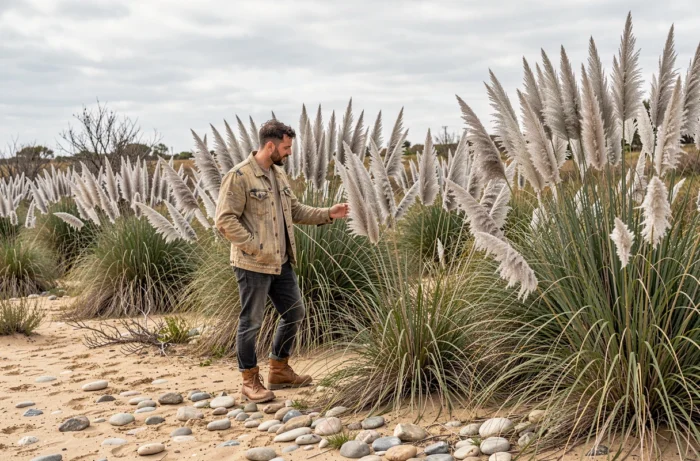
Cortaderia selloana preferentially colonizes Atlantic coastal wastelands, from southern Brittany to the Basque Country. Highway embankments, the edges of industrial areas, and peri-urban vacant lots are the most accessible stations. The species thrives in well-drained, even poor soil, and tolerates salt spray.
The Mediterranean perimeter also hosts populations, but in a more dispersed manner. We observe sporadic stations along waterways and in filled areas of Languedoc and the Côte d’Azur. In continental areas, the plant remains rare: harsh winters limit its spread beyond the Loire.
Identifying stations without relying on online lists
The “foraging addresses” shared on social media quickly become outdated. An embankment mowed by the municipality in August will offer nothing in October. The reliable method is to spot the clumps from the road during the summer, when the flower spikes rise and are visible from a distance, then return in the fall once the plumes are dry.
The edges of railway tracks should be excluded: access is prohibited and the land belongs to SNCF Réseau. Departmental road margins offer a simpler setting, provided you park safely.
Cutting techniques and preservation of dried stems
A pair of pruning shears or hedge trimmers is sufficient. The stem of Cortaderia selloana, even when dry, reaches a notable diameter at the base. Cutting about thirty centimeters from the ground avoids uprooting the clump and preserves the crown.
At the time of cutting, wear thick gloves. The leaves of the clump are finely serrated and can cause clean, sometimes deep cuts. The English vernacular name, “razor grass,” is not exaggerated.
Fixing the plumes and drying
- Spraying hair spray on the plume immediately after cutting limits the loss of plumes during transport and drying.
- Hanging the stems upside down in a dry, ventilated area for one to two weeks consolidates the structure of the plume.
- Avoid drying in direct sunlight: UV rays degrade the color and make the plumes brittle in a few days.
A well-dried plume retains its volume for several years without additional treatment. Occasional application of hairspray extends its durability if the indoor environment is very dry or exposed to drafts.
The free foraging of pampas grass remains an accessible practice, provided one respects the regulatory framework of 2023, targets truly dry spikes, and checks the land status before any harvesting. A plume harvested at the right stage, from an authorized site, will decorate an interior without contributing to the dissemination of a species whose spread in mainland France already poses measurable ecological challenges.