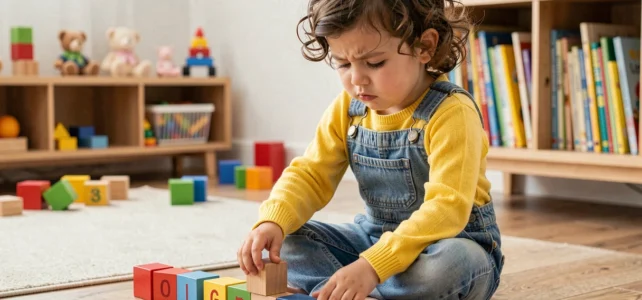
Between 2 and 3 years old, most children begin to recite the first numbers without actually knowing how to count objects. This distinction between number rhyme and actual counting changes the way we conceive a printable activity for this age group. Worksheets designed for toddlers do not target the same skills as those for preschool or kindergarten, and confusing the two leads to offering exercises that are too ambitious or poorly calibrated.
Number rhyme and counting: two distinct skills before age 3
A 2-year-old child who says “one, two, three” while vaguely pointing does not count. They are reciting a learned sequence by imitation, like a song. The ability to associate each number word with a specific object, and then to understand that the last number spoken represents the total quantity, appears later.
Recent educational summaries confirm that reliable counting beyond 2 or 3 objects only appears around age 4. In preschool, French programs set a limited objective: to recognize at a glance 1, 2, or 3 elements, and to count up to 3. Comparisons of larger collections and counting up to 5 or 6 fall under kindergarten.
When choosing a printable activity for 2-3 year olds, this benchmark is crucial. A worksheet that asks to count 7 apples or to connect the number 8 to a collection of stars exceeds the actual capabilities of this age group. The most relevant worksheets are limited to quantities of 1, 2, and 3, with very contrasting visuals.
Printable worksheets for counting up to 3: what works on paper
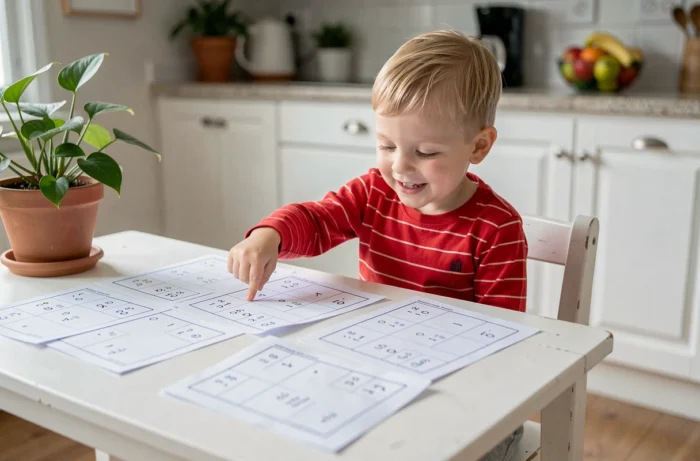
The paper medium imposes a constraint that physical games do not have: the child does not manipulate three-dimensional objects. They point, color, glue, or circle. This limitation guides the type of printable activity that makes sense for a 2-3 year old child.
Visual recognition of small quantities
The most suitable worksheets exploit subitizing, the ability to perceive a quantity without counting one by one. At this age, a child can spontaneously recognize 1, 2, or 3 clearly arranged objects. An effective worksheet might present two groups of images (a basket with 2 fruits and another with 3 fruits) and ask to color the one that has “the same” as a model.
Instructions should remain visual. A pictogram or color code effectively replaces a written sentence that the adult would need to read aloud each time.
Number-quantity association with very small collections
Associating the written number “2” with a drawing showing two objects is a first step towards numeration. However, offering this association for numbers 1 to 10 on the same worksheet dilutes the learning. Field feedback varies on the exact moment to introduce the written number, but most educational resources recommend starting with quantity alone, then gradually introducing the symbol.
- Matching worksheet: one column with the numbers 1, 2, 3 and another column with groups of objects to connect. Three pairs are sufficient for a child of this age.
- Collage worksheet: the child glues the correct number of stickers in a box under each number. The motor gesture reinforces the association.
- Directed coloring worksheet: “color 2 fish” among 4 drawn. The child must stop at the right moment, which engages active counting.
Limits of printable activities for learning to count at age 2
Paper does not replace the manipulation of concrete objects. Stacking blocks, distributing plates at the table, or placing chestnuts in a bowl engage hand-eye coordination and counting in real situations. A printed worksheet complements these experiences but does not replace them.
A 2-year-old has a limited attention span on a static medium. A worksheet that is too cluttered, with several exercises on the same page, risks causing quick abandonment. The most usable worksheets contain a single exercise per page, with illustrations large enough for the child to point at without ambiguity.
The other limitation concerns repetition. Counting is learned through regular and varied practice, not by completing a single worksheet successfully. Having a set of worksheets that repeat the same type of exercise with different visuals (animals, fruits, vehicles) helps consolidate the skill without boring the child.
Choosing counting worksheets suitable for preschool
Not all worksheets labeled “preschool” are suitable for 2-3 year olds. Many online resources group preschool, kindergarten, and first grade together without distinction, resulting in exercises calibrated for 4 or 5-year-olds.
To identify a truly suitable worksheet, a few concrete criteria help to sort:
- Quantities do not exceed 3 (or 5 at most for a child at the end of preschool who is already comfortable).
- The instruction is understandable by the image alone, without the child needing to read text.
- The format allows space: wide illustrations and a single exercise per page avoid visual overload.
- The activity requires a gesture (coloring, circling, gluing) and not just passive observation.
Worksheets that ask to trace the number (graphism) belong to a different learning process. At 2-3 years old, tracing numbers is premature for most children, whose fine motor skills are not yet ready to reproduce precise shapes.
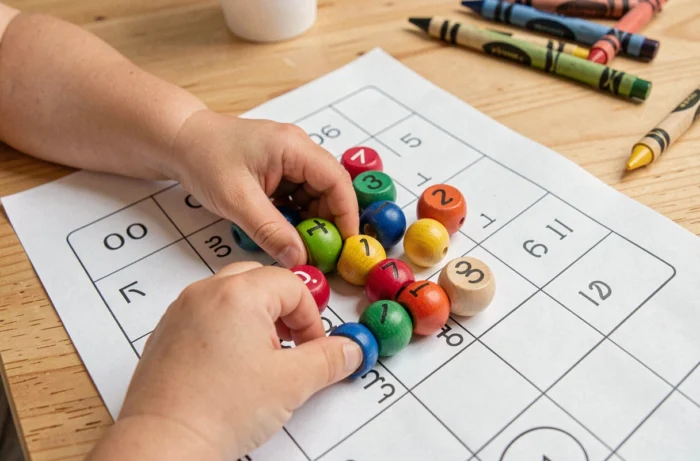
Learning to count at this age relies on the repetition of simple situations, grounded in the concrete. Sticking to quantities of 1, 2, and 3 with streamlined worksheets yields more solid results than multiplying ambitious exercises. The written number will come later, once the child has stabilized their understanding of what “two” or “three” really means.