
In the second-hand market, the year of manufacture of a mobile home determines its price, its installation possibilities in campsites, and its compliance with current regulations. This information is not always clearly displayed on the property, and sellers do not systematically mention it. Several methods allow for its retrieval, but none offer the same reliability depending on the condition of the mobile home and the available documentation.
Chassis plate and manufacturer code: the reference method for dating a mobile home
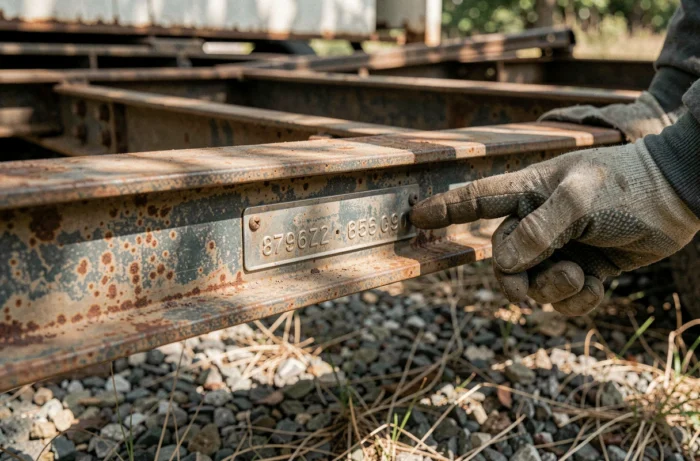
The first thing to check is the identification plate fixed to the chassis. It is usually found on the drawbar (the front part used for towing) or under the leveling plan. This plate carries a unique identification code from the manufacturer, which includes or allows for the retrieval of the year of manufacture.
The most straightforward reflex is to note this number and contact the manufacturer. Major French manufacturers (Rapidhome, IRM, Résidences Trigano, O’Hara, for example) have internal databases that associate each chassis number with a specific vintage. The response generally arrives within a few days.
When trying to determine the year of a mobile home whose plate is missing or illegible, the process becomes more complicated. Detailed photos of the exterior and interior, sent to the manufacturer, may suffice to identify the model and generation. Manufacturers modify their ranges each year (layout, facade style, type of joinery), which often allows them to associate a mobile home with a production period even without a serial number.

Visual and technical clues when the plate has disappeared
The missing plate is a common case for mobile homes over fifteen years old. Oxidation, poorly managed relocation, or chassis replacement can be the cause. In this situation, visual inspection becomes the main tool for dating.
Joinery and insulation
Windows are a reliable indicator. Mobile homes manufactured before the mid-2000s predominantly used single glazing with thin aluminum profiles. The gradual transition to double glazing and thicker PVC profiles became widespread afterward. A mobile home equipped exclusively with single glazing most likely dates from before this transition period.
The thickness of the walls and floor also provides indications. Recent models feature enhanced insulation, with walls noticeably thicker than those of previous generations.
Interior layout and equipment
Finishes evolve in cycles. Here are some useful markers:
- Wall coverings in light PVC paneling and carpets on the floor indicate older models, often predating the years 2005-2010.
- The appearance of bathrooms with Italian showers and open kitchens with thick laminate countertops corresponds to ranges produced from the early 2010s.
- Integrated air heating systems, as opposed to basic wall convectors, have spread to newer models.
These clues do not provide an exact year. They help place the mobile home within a range, which is useful for spotting an ad where the stated vintage would be inconsistent with the actual condition of the property.
Manufacturer vintage and actual year: a gap to be aware of
One point that private listings often overlook: the vintage displayed by the manufacturer does not always correspond to the calendar year of manufacture. As in the automotive industry, some manufacturers assign a vintage in advance. A mobile home labeled “2024” may have been assembled at the end of 2023.
This gap plays a concrete role during resale. A buyer relying on the vintage may overestimate the youth of the property. To clarify the ambiguity, it is the date on the original purchase invoice or delivery note that serves as the reference. The original invoice remains the most reliable document for dating a mobile home, ahead of the commercial vintage.
Consequences of the year of manufacture on campsite installation
The year of manufacture is not only of historical interest. Most campsites and residential leisure parks (PRL) apply age rules to accept a mobile home on their grounds. A mobile home deemed too old will be refused installation, even if it is in good condition.
Each campsite freely sets its maximum age threshold, which generally varies between fifteen and twenty years. This threshold is stated in the plot rental contract. Before any second-hand purchase intended for installation in a campsite, checking this point in the contract avoids an unpleasant surprise.
For mobile homes registered and intended to be driven on the road (in the case of relocations), the year of first registration also comes into play. Vehicles whose first registration is prior to December 31, 1996 cannot obtain a Crit’Air sticker, which restricts their access to low-emission zones in several French municipalities.
Cross-checks before a second-hand purchase
No single method is sufficient. Reliability relies on cross-referencing multiple sources:
- The chassis number, verified with the manufacturer, provides the exact year of production.
- The original purchase invoice or delivery note confirms the date of commissioning.
- Visual inspection (joinery, insulation, layout) allows for spotting a vintage inconsistent with the actual condition.
- The campsite plot rental contract sometimes mentions the year of the mobile home declared at installation.
When a seller cannot provide either a chassis number or invoice, the lack of traceability serves as a warning signal. Field reports vary on this point: some buyers obtain information directly from the campsite where the mobile home was installed, while others find themselves without reliable recourse. In any case, a mobile home without verifiable documentation is negotiated downwards, and for good reasons.