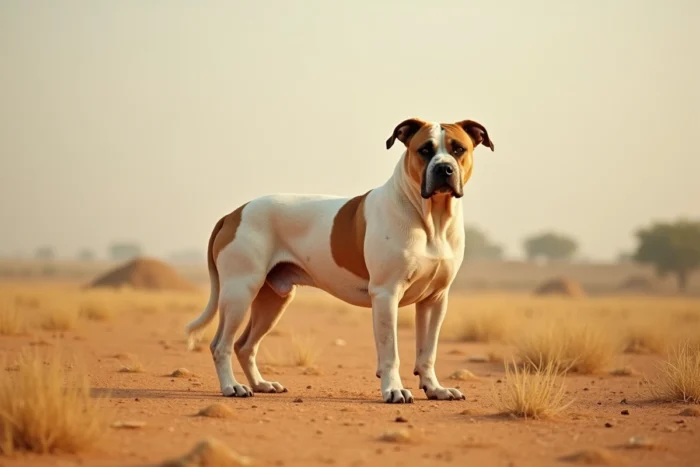
The Bully Kutta is one of those breeds that destabilizes at first glance. A massive build, a neck covered in skin folds, a wide jaw: everything in its silhouette evokes raw power. This mastiff, originating from the Indian subcontinent, remains poorly known in France, often confused with the American Bully or the Argentine Dogo. Understanding this dog begins with tracing its geographical roots and accepting that it is not suited for everyone.
Bully Kutta: a canine heritage of Sindh and Punjab
Most breed profiles start with a quick summary of origins. For the Bully Kutta, the history deserves attention because it directly explains its current temperament.
The name “Bully Kutta” likely comes from the Hindi-Urdu word “bohli,” which means “heavily wrinkled,” combined with “kutta” (dog). The breed is also known as Sindh Hound, Alangu Mastiff, or Indian Mastiff. It was born in the regions of Sindh and Punjab, straddling present-day India and Pakistan, where it served to guard farms and livestock.
Since the 2010s, a local awareness has emerged. Breeders and activists now present the Bully Kutta as a regional canine heritage to protect, in contrast to the underground fighting networks that have long tarnished its reputation. The focus is on character selection and temperament stability, rather than muscle mass or aggression. To better understand the characteristics of the bully kutta, one must keep in mind this recent shift in breeding philosophy.
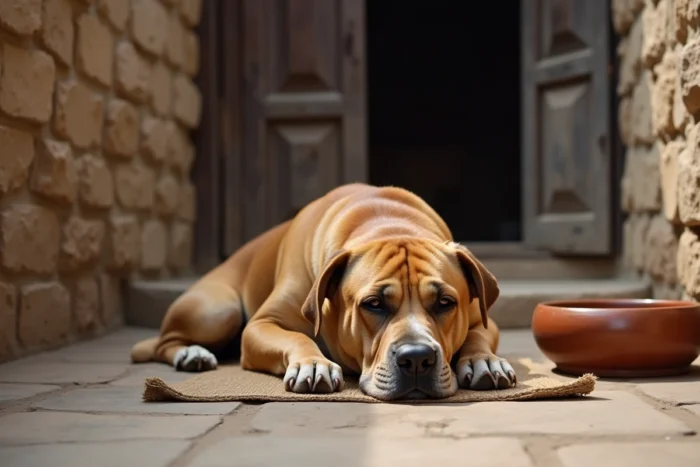
Temperament of the Bully Kutta: natural guarding and assertive dominance
Have you ever observed a dog monitoring a perimeter without being asked? The Bully Kutta does exactly that. Its guarding instinct is embedded in its genetics, selected over generations to protect agricultural properties and later industrial sites in the suburban areas of Punjab and Sindh.
This dog does not bark for no reason. It assesses, observes, then reacts. This apparent restraint should not be confused with passivity. Its dominance is natural and expresses itself very early, from the first months of life. Without a clear framework, an adolescent Bully Kutta will systematically test its owner’s limits.
Some temperament traits to remember:
- A pronounced territorial instinct that makes it wary of strangers, including regular visitors to the home
- A strong loyalty to a primary reference, which can create tensions in a large family if the hierarchy is not established
- A very limited tolerance towards other same-sex dogs, especially unneutered males
This profile makes the Bully Kutta a dog suited for individuals who have already managed mastiffs or working breeds. This is not a first dog, nor a typical family dog.
Size and health of the Bully Kutta: what size implies in daily life
An adult male can reach between 76 and 86 cm at the withers, weighing between 70 and 90 kg. Females remain slightly more compact, between 75 and 80 cm for 60 to 70 kg. This size has direct consequences on daily life.
Transporting this dog to the veterinarian, holding it during a procedure, providing an appropriate resting space: every mundane action with a medium-sized dog becomes a logistical exercise with a Bully Kutta. The minimum living space is a house with a fenced yard. An apartment is not suitable.
Health watch points
Dogs of this size share vulnerabilities common to giant breeds. The joints (hips, elbows) are under constant pressure. Growth must be closely monitored during the first two years, a period when the skeleton solidifies.
The life expectancy of the Bully Kutta ranges from 5 to 12 years, a wide range that largely depends on lineage and breeding conditions. Regular veterinary check-ups and a diet tailored to the actual weight (not the dog’s appetite) are two concrete levers to approach the upper end of this range.
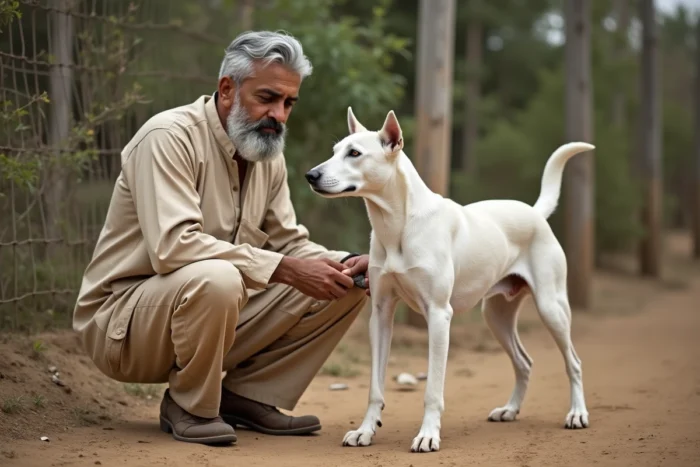
Breeding the Bully Kutta: early socialization and positive reinforcement
Training a Bully Kutta is not just about “being firm.” Firmness without method produces a wary or reactive dog, not a balanced one.
Socialization should begin before the puppy is three months old. This means exposing it to varied environments, different people, and other animals in controlled conditions. Why so early? Because the socialization window closes quickly in highly dominant breeds. A Bully Kutta that has only met its breeder and mother during its first twelve weeks will be much more difficult to socialize later.
- Favor positive reinforcement (food rewards, play) over physical correction, which increases distrust in this breed
- Establish clear daily routines: fixed meal times, regular walking times, constant forbidden areas
- Never leave a Bully Kutta in free interaction with young children, even if it seems calm
- Work on recall from a young age, as an 80 kg dog without reliable recall becomes unmanageable outdoors
Finding a serious breeder
The breed is not recognized by the FCI or the Société Centrale Canine in France. This means there is no official standard governing selection. Serious breeders stand out for their transparency regarding lineages, health tests conducted on breeding stock, and their willingness to place puppies with experienced owners.
A breeder who sells a Bully Kutta without asking questions about your dog experience or living situation is likely not reliable. Selection for character stability takes precedence over appearance.
The Bully Kutta remains a working dog repurposed as a guardian. Its place is with people who understand mastiffs, have suitable land, and commit to structured training from day one. It is neither a trendy dog nor an ordinary pet, but a demanding companion that, when well-guided, fulfills its role with rare efficiency.