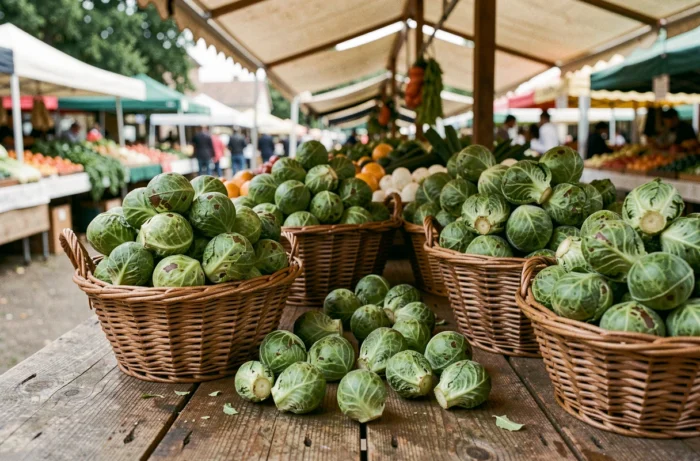
Brussels sprouts consistently appear in almost all surveys as the vegetable that the French push to the edge of their plates. An OpinionWay survey conducted for HelloFresh in 2025 ranks this vegetable as the most rejected among children, with 51% of mentions. Fennel and salsify closely follow, each at 48%.
However, this ranking, often quoted as is, masks a more nuanced reality: there is no official classification designating a single vegetable as “the least liked” across the adult French population.
Bitter Taste and Sulfur Compounds: What the Biology of Taste Really Explains
The rejection of Brussels sprouts, turnips, endives, or broccoli is not merely a matter of whim. These vegetables share sulfurous molecules (glucosinolates) that, when cooked, release compounds perceived as bitter. Children’s taste buds detect this bitterness more intensely than those of adults, which establishes disgust very early on.
This sensitivity also varies from individual to individual. Some people have taste receptors that are more reactive to bitterness, making the experience of eating a Brussels sprout significantly more unpleasant than for a dining companion.
The question of which vegetable is the least liked by the French thus depends as much on individual genetics as on dietary habits passed down through family or at school cafeterias.
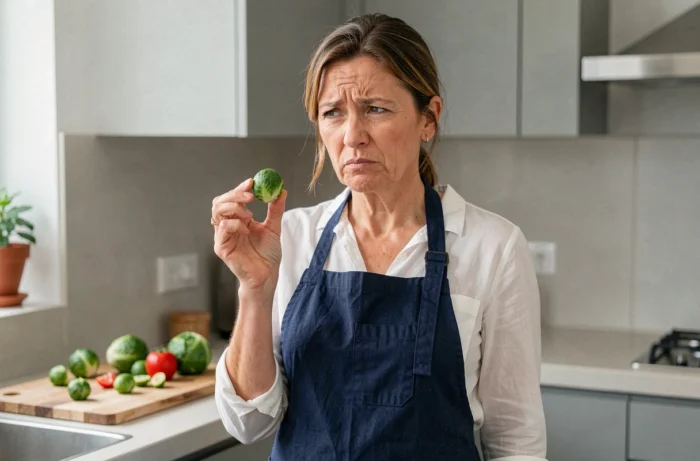
Hated Vegetables in France: The Underestimated Role of Cooking Methods
Boiling Brussels sprouts in a large pot of water for twenty minutes is the historical method of French collective catering. The result: a mushy texture, a sulfurous smell that fills the room, and a bitter taste that nothing compensates for. This method of preparation has likely caused more reputational damage than biology itself.
Roasted in the oven with a drizzle of olive oil, Brussels sprouts lose some of their bitterness and develop caramelized notes. The same principle applies to braised endives or glazed turnips. The Maillard reaction transforms surface sugars and mitigates the perception of sulfurous compounds.
The problem is that the taste memory of the cafeteria remains ingrained. A food behavior study does not only measure an objective taste: it also captures years of conditioning through inappropriate preparations.
Three Vegetables Whose Reputation Changes Depending on the Recipe
- Spinach, often hated when boiled, finds its supporters when sautéed with garlic or added raw to a salad
- Cauliflower, bland after boiling, becomes crispy and flavorful in a gratin or roasted with spices
- Fennel, with its overly pronounced anise flavor for many, softens considerably when slowly cooked in the oven with parmesan
Vegetable Consumption in France: A Deficit That Goes Beyond Disgust
Reducing the low vegetable consumption to mere taste rejection would be a mistake. According to a publication from UNILET based on the Nutrimétrie study (September 2026), only 9% of children and 13% of adults reach the benchmark of five fruits and vegetables per day. The problem is therefore massive and structural.
Obstacles are also practical and economic. RTL reported in September 2026 that price, preparation time, and lack of knowledge about cooking methods hinder the purchase of fresh vegetables. Frozen vegetables appear as a lever: they eliminate peeling, reduce waste, and preserve most nutritional qualities.
Frozen vegetables represent a channel for reconciling with unloved vegetables. A bag of pre-cooked Brussels sprouts ready to roast lowers the entry barrier for a consumer who would never have bought this vegetable in the fresh produce aisle.
What the Data Doesn’t Say
The available surveys often question children or focus on small samples. No large-scale national survey ranks vegetables in order of dislike among French adults. Field feedback diverges on this point: some restaurateurs place turnips or salsify ahead of Brussels sprouts in the hierarchy of rejection.
This lack of consolidated data leaves room for informal rankings, repeated from article to article without verification. Brussels sprouts inherit a self-perpetuating bad reputation, reinforced by popular culture and social media.
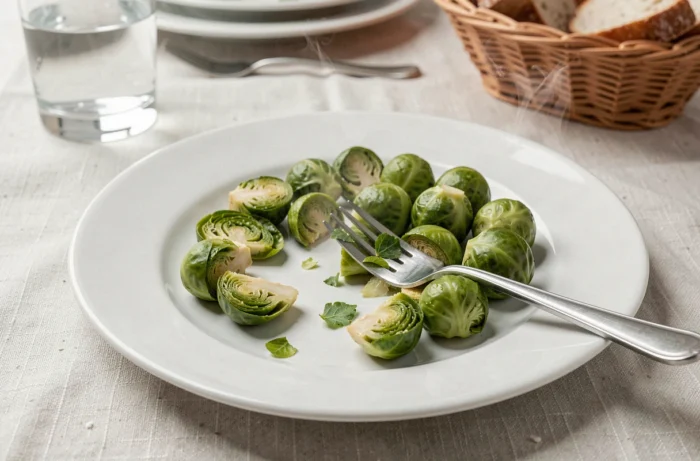
School Cafeteria and Food Memory: Where Disgust is Constructed
The cafeteria remains the place where most French people first encountered the vegetables they hate. Collective catering, constrained by tight budgets and large volumes, favors quick cooking methods in water. The taste result has nothing to do with a carefully prepared home dish.
The memory of a bad cafeteria dish can condition food rejection for decades.
Recent initiatives in some communities (introduction of on-site vegetable bars, recipes developed by chefs) aim to reverse this dynamic. Initial feedback is encouraging, but the available data does not yet allow for measuring a lasting change in students’ preferences.
Brussels Sprouts: A Symbol of a Broader Food Rejection
Pointing to a single vegetable as “the most hated” simplifies a complex phenomenon. Rejection affects an entire family of cruciferous and bitter vegetables. It is constructed at the intersection of genetics, collective cooking, the price of fresh products, and family habits.
The next time Brussels sprouts top a survey, it will be useful to check who was surveyed, at what age, and especially how the vegetable was prepared. The answer to this last question often changes the entire ranking.