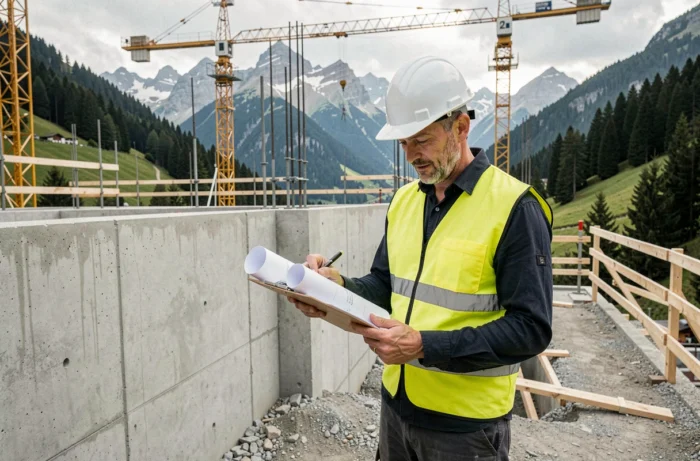
The Swiss construction market is experiencing a period of conflicting pressures: a housing shortage, a gradual tightening of cantonal energy standards, and increasing technical requirements on construction sites. In this context, construction companies must demonstrate their ability to cover the entire chain, from design to delivery, while integrating regulatory constraints that evolve from canton to canton.
MuKEn 2025 and cantonal regulations: what changes for construction projects in Switzerland
The new energy regulations of the cantons, known as MuKEn 2025, redefine the requirements applicable to new buildings and major renovations. Their uniqueness lies in the adoption mechanism: each canton must incorporate these rules into its own legislation, creating temporal discrepancies and local variations.
For a construction company active in several cantons, this regulatory mosaic complicates the standardization of processes. A project in Geneva may require different insulation levels or heating production systems compared to a comparable site in the canton of Vaud or Fribourg. Field feedback varies on the actual speed of adoption of these standards by cantonal administrations.
A company that structures its services around this reality – regulatory monitoring, adaptation of materials and technical solutions according to the canton – offers a concrete advantage to its clients. By browsing the entire Yvazur Construction website, one can see how a Swiss company organizes its services to respond to this diversity of regulatory frameworks.
Energy renovation and incentive program: a lever for construction companies
The Building Program was supplemented on January 1, 2025, by an incentive program targeting, in particular, the replacement of decentralized electric heating, large fossil installations, and certain work on the building envelope. This expanded system represents a significant flow of projects for construction and renovation companies.
According to the Federal Statistical Office, one quarter of residential buildings had a heat pump in 2025, a proportion that has increased sixfold since 2000. Despite this progress, half of the buildings were still heated with fossil fuels. The potential for transformation is therefore considerable.
For companies in the sector, this means that mastering the work related to the energy transition (thermal insulation, boiler replacement, integration of heat pumps) becomes a differentiating criterion. Clients, whether private owners or municipalities, seek providers capable of managing both the technical aspects and the preparation of grant applications.
Grants and project management: a core competency
Access to federal and cantonal grants requires a thorough understanding of eligibility criteria, submission deadlines, and the technical documentation to be provided. A construction company that integrates this dimension into its project management helps its clients avoid delays or funding refusals.
The available data does not allow for conclusions about the average refusal rate of applications, but industry professionals regularly report incomplete or poorly calibrated files. The quality of administrative support becomes a service in its own right.
Housing shortage and new construction: operational constraints in Switzerland
Switzerland is experiencing a housing deficit that the recent construction recovery is not sufficient to fill. New construction projects face several bottlenecks that go beyond just the building permit issue:
- The timeframes for obtaining permits vary significantly from one canton to another, with opposition procedures that can block a site for several months
- The supply of construction materials remains subject to occasional tensions in certain sectors, necessitating proactive order management
- Coordination between trades on the same site requires rigorous project management, especially when contractual deadlines are tight
- The quality requirements imposed by SIA standards govern every phase of the project, from design to acceptance of the work
The management of deadlines and costs on a Swiss construction site depends as much on upstream planning as on responsiveness to unforeseen events. A company that offers services covering architecture, project management, and project development reduces the number of stakeholders and the risks of disruption in the decision-making chain.

Services of a Swiss construction company: what the term “turnkey” really means
The term “turnkey” is used by the majority of construction companies in Switzerland, but its actual scope varies significantly from one provider to another. Some companies limit themselves to structural work and subcontract all finishing work. Others integrate architectural design, permit management, artisan coordination, and post-delivery follow-up.
A “turnkey” project only makes sense if the provider masters the entire chain, from feasibility study to handover. The points of vigilance for a project owner are as follows:
- Does the company have an integrated team of architects or does it only work with external partners?
- Is project management handled internally, with a single contact throughout the project?
- Are past achievements documented and verifiable, with accessible references?
On the other hand, a company that showcases diverse achievements (villas, apartment buildings, major renovations, promotional projects) demonstrates an adaptability that single-activity structures cannot offer. The diversity of the project portfolio remains a reliable indicator of operational strength.
Achievements and transparency: an underestimated selection criterion
The galleries of achievements published online often serve as the first filter for a potential client. A documented project with photos from different phases (earthworks, structure, finishes) provides more credibility than a simple list of theoretical services.
Transparency regarding delivered projects differentiates established companies from newer structures. A history of varied projects, located in several municipalities or cantons, reflects experience faced with different regulatory and technical contexts.
The Swiss construction sector faces dual pressure: to meet the growing demand for housing while adhering to increasingly stringent energy and construction standards. Companies that document their achievements, structure their services around the real constraints of the field, and support their clients in the administrative aspect position themselves in a segment where trust is built project by project.