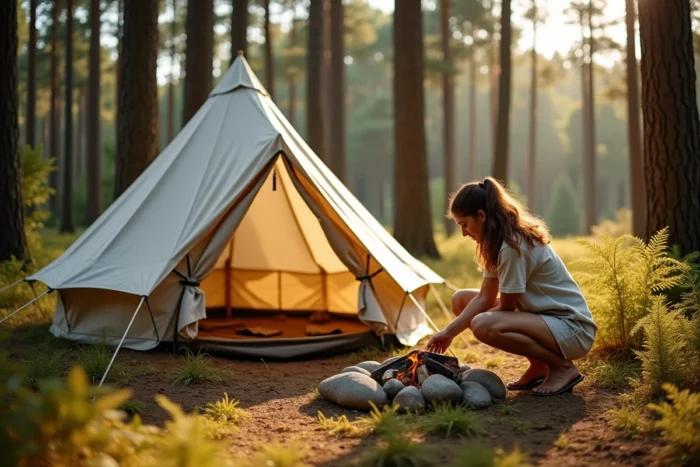
The Landes pine forest under a tent in July is primarily a question of thermal comfort. A south-facing pitch without vegetation cover turns any tent into a sauna by 10 a.m. Recent field reports on campsites along the Landes coast converge: campers prioritize shade and the condition of sanitary facilities well before the nightly rate.
Thermal comfort under a tent in the Landes: criteria not detailed in commercial listings
A “shaded” pitch in a campsite description encompasses very variable realities. Between a mature maritime pine whose high canopy barely filters vertical sunlight and a cork oak whose dense foliage casts low shade, the temperature difference felt under the tent easily exceeds several degrees.
We recommend checking three parameters before booking a tent pitch in this region:
- The nature of the tree cover: maritime pines, predominant in the Landes forest, provide airy but incomplete shade. A pitch under mixed broadleaf trees offers better heat protection than a plot in pure pine forest.
- The orientation of the plot: an east-west exposed pitch receives the low sun in the morning and evening, allowing for a respite in midday if the cover is adequate. A south-facing exposure without vegetation remains problematic.
- The distance to sanitary blocks: beyond cleanliness, the proximity of showers affects nighttime comfort. Being able to cool off without crossing the entire campsite at 11 p.m. changes the quality of sleep.
Those who have been camping in tents in the Landes for several seasons know this: the coolness of a pitch is recognized on-site, not from an aerial photo. Requesting the plot plan with tree species at the time of phone booking remains the best reflex.
Sanitary facilities in Landes campsites: what distinguishes a decent block from a problematic one
Recent reviews of Landes campsites frequently cite sanitary facilities as the primary reason for satisfaction or disappointment. A 4 or 5-star campsite does not automatically guarantee flawless sanitary blocks during peak season when occupancy rates approach maximum.
The ratio of showers to occupied pitches is the real indicator. A new but undersized block generates queues during peak hours (8 a.m.-9 a.m. and 6 p.m.-8 p.m.). Conversely, an older block that is properly sized for tent areas remains functional.
Some signals to look for:
- The presence of individual closed cabins (not just open shower stalls separated by a curtain), which significantly improve comfort for families with children.
- A cleaning schedule displayed at least twice a day during high season, with a visible timetable.
- Electrical outlets in or near the block, useful for charging phones and headlamps without running a cable from the pitch’s power point.
- The existence of a dishwashing area and a separate waste disposal space from the shower block, which prevents congestion.
Since January 1, 2024, source separation of bio-waste is mandatory for all producers, including campsites. Specifically, establishments must provide a food waste collection point accessible to campers. From January 1, 2025, waste sorting outside the home will be mandatory in public establishments. A campsite that has not yet implemented these facilities shows a regulatory delay that speaks volumes about its overall management.
Landes forest or coastline: two very different camping atmospheres
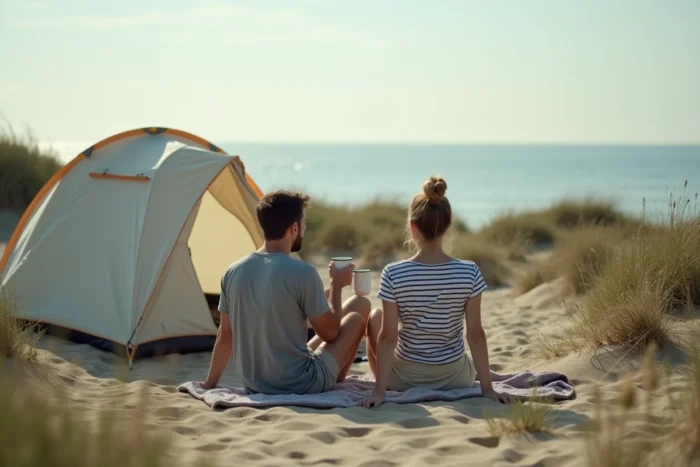
Spots close to the ocean (Ondres, Messanges, Moliets) offer quick access to beaches and the sea breeze that cools the heat in the evening. The downside: pitches are often more exposed to the wind, sandy soil complicates anchoring tent pegs, and camper density is higher in July-August.
Campsites set back in the Landes forest offer more spacious plots and a tranquility that is hard to find along the coastal strip. Proximity to lakes (Sanguinet, Parentis, Aureilhan) compensates for the absence of the ocean for swimming. The forest floor, more loose and shaded, maintains a ground temperature significantly lower than an open sandy area.
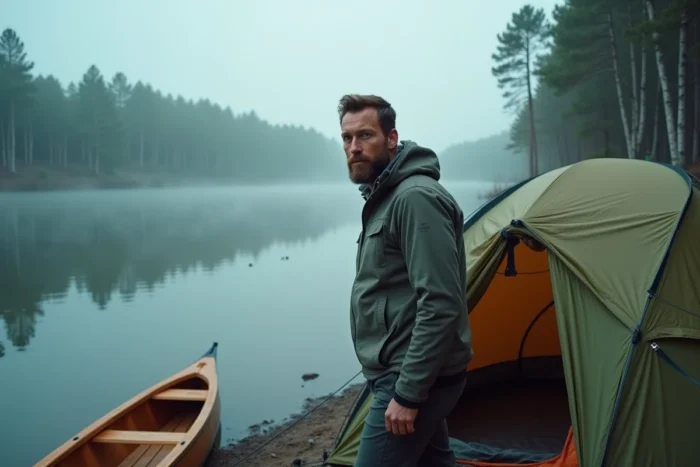
For families with children, the decisive criterion often leans towards the coastline due to water activities and children’s clubs at large campsites. For campers seeking calm and coolness, pitches in the forest between lake and undergrowth remain superior in terms of thermal comfort.
Bivouacking and wild camping in the Landes: what the regulations actually allow
Pitching a tent outside a designated campsite in the Landes falls under strict legal regulations. Wild camping is prohibited along the coastline, in classified sites, and near historical monuments. In the Landes state forest, the prohibition is reinforced by fire risk, particularly between June and September.
Bivouacking (light setup from sunset to sunrise, without facilities) is tolerated in certain areas, but recent developments in France show a general tightening. Several natural areas now require reservations, time slots, and designated zones to regulate the practice.
In the Landes, bivouacking in communal forests requires the agreement of the owner or manager. Forest rangers from the ONF regularly penalize unauthorized setups, especially during forest fire vigilance periods. We observe that the confusion between “tolerated bivouacking” and “authorized wild camping” remains the primary source of problems for independent campers.
Choosing a pitch in a designated campsite in the Landes means balancing heat, shade, cleanliness of facilities, and site ambiance. The price per night matters, but a poorly shaded pitch at a reduced rate can be costly in lost comfort from the very first morning of a heatwave. Calling the campsite to ask for the plot number and its position relative to trees remains the best guarantee of a successful stay under canvas.