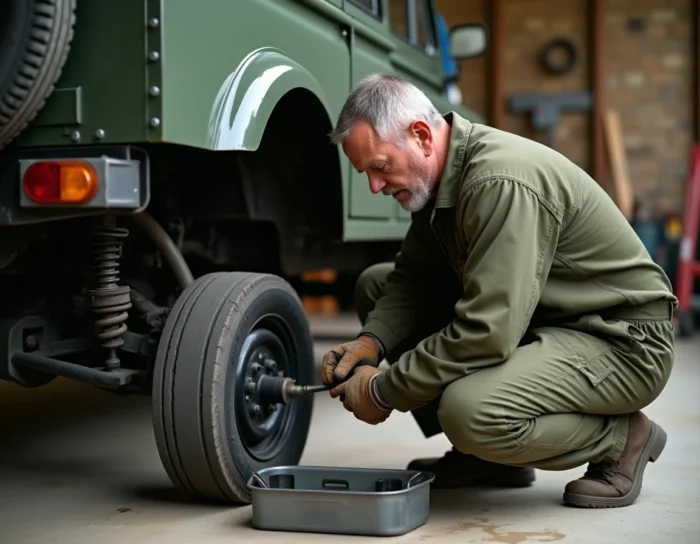
The Peugeot P4, derived from the Mercedes G-Class produced under license for the French army, presents very different maintenance constraints compared to a standard civilian vehicle. Its withdrawal from the military fleet means there is no follow-up from the traditional manufacturer network, specific parts must be sourced elsewhere, and its usage profile is often intermittent, which accelerates certain degradations. Which maintenance aspects deserve particular attention on this retired 4×4, and which are overestimated by general guides?
Peugeot P4 Spare Parts: Supply and Mercedes Compatibility
The first reflex after acquiring a retired P4 is to map out the availability of parts. The mechanical kinship with the Mercedes G-Class (engine, transmission, axles) opens access to a supplier network that is broader than one might assume.
| Maintenance Item | P4 / Military Source | Mercedes G-Class Compatibility |
|---|---|---|
| Engine filters (air, oil, fuel) | Specialized 4×4 catalogs | References often identical |
| Brake pads and discs | Dedicated P4 suppliers | Compatible on most models |
| Steering components | Specialized 4×4 catalogs | Partial (ball joints, tie rods) |
| Cooling hoses | Dedicated P4 suppliers | Similar dimensions, case-by-case verification |
| Body parts | Retired military stock / scrap | Not compatible (specific Peugeot body) |
Several specialized 4×4 suppliers now offer specific Peugeot P4 catalogs covering routine maintenance: filters, hoses, braking parts, steering components. This dedicated network compensates for the lack of manufacturer follow-up.
For mechanical components shared with the G-Class, compatibility remains the main lever for maintaining a retired Peugeot P4 without relying on a dwindling stock of military parts. On the other hand, the body and certain specific equipment (equipment mounts, tactical lighting) have no civilian equivalent and require used stock or custom manufacturing.

P4 Diesel Engine Maintenance: Adjusting Intervals to Actual Usage
The majority of retired P4s in civilian circulation cover modest distances, often a few hundred kilometers per month. This low-mileage vehicle profile alters maintenance priorities compared to standard mileage recommendations.
Oil Change and Lubrication
On a diesel engine that runs rarely, oil accumulates moisture through condensation. The mileage displayed between oil changes matters less than the elapsed time. An annual interval remains a minimum, even if the odometer hasn’t moved significantly.
Stagnant oil degrades internal seals faster than frequently used oil. On an engine from the 1980s-1990s like that of the P4, rubber sealing rings lose their flexibility without regular operating heat. Running the engine at operating temperature at least once a month limits this phenomenon.
Cooling System
Coolant chemically ages, regardless of mileage. On a stored P4, replacing it every two years prevents internal corrosion of the system. The original rubber hoses, if not changed, are particularly vulnerable to hardening and micro-cracks.
- Check the condition of the hoses at each seasonal change: rubber that cracks under finger pressure should be replaced immediately
- Inspect the thermostat, which can remain stuck in the open position after years of low use, preventing the engine from reaching its optimal temperature
- Bleed the system after each fluid replacement to avoid air pockets, which can cause localized overheating on an old block
Battery and Electrical System on Retired Military Vehicle
The electrical system of a P4 is rudimentary compared to that of a modern vehicle, simplifying diagnostics but not eliminating issues related to prolonged storage.
For older Peugeots used in collections or intermittently, installing a battery disconnect switch for classic vehicles is recommended by several specialists. This device physically isolates the battery from the circuit, eliminating micro-consumptions that cause a deep discharge within a few weeks of storage.
A repeated deep discharge irreversibly reduces the capacity of a lead battery. On a P4, where the starter heavily draws on the battery (diesel engine, high compression), a partially discharged battery accelerates starter wear.
Manual Steering and P4 Running Gear: Specific Checkpoints
The P4 is equipped with manual steering without assistance, making the condition of steering components all the more noticeable at the wheel. Abnormal play translates immediately into vague handling, where power steering would partially mask the defect.
- Steering ball joints and tie rods endure significant stress off-road and should be inspected annually, even on a little-used vehicle
- The protective boots of the ball joints crack over time, exposing the joints to water and dust: a split boot necessitates immediate replacement of the entire assembly
- Play in the steering box is adjusted with shims; beyond a certain threshold, the box must be refurbished or replaced
Steering components are included in the specialized 4×4 catalogs dedicated to the P4, with compatible references sourced from the Mercedes network for certain ball joints and tie rods. Verifying this compatibility before ordering avoids returns and delays.
The running gear of a retired military vehicle has often been subjected to abrasive terrains. Suspension bushings, even if they appear visually correct, may have lost their elasticity. A road test attentive to noise and vibrations remains the best diagnostic.
The longevity of a retired Peugeot P4 relies less on the frequency of interventions than on their relevance. A vehicle that drives little but whose fluids, rubbers, and electrical system are monitored according to a time-based schedule (rather than mileage) maintains its mechanical reliability well beyond what its age would suggest.