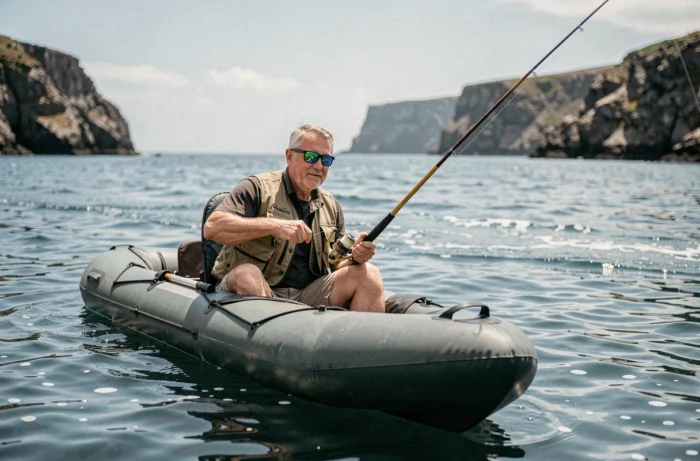
An inflatable canoe designed for sea fishing is not chosen like a model for rivers or lakes. The constraints of the marine environment (salt, chop, coastal currents, prolonged UV exposure) impose construction and layout criteria that most consumer buying guides treat superficially. Here, we detail the technical points that make the difference between an inflatable suitable for real conditions and a disappointing purchase by the second season.
Laminated PVC, deniers, and salt resistance: the material determines longevity
The composition of the fabric of the cover is the first filter for selection. A single-layer PVC degrades quickly upon repeated contact with saltwater and UV rays. We recommend targeting constructions made of reinforced three-layer laminated PVC with a minimum of 1000 deniers, a standard that has become common in fishing-oriented models in recent years.
User feedback over several seasons confirms that these multi-layer covers significantly reduce problems of cracking, delamination, and loss of pressure. The condition remains rigorous maintenance: systematic rinsing with fresh water after each outing and storage away from direct sunlight.
Choosing an inflatable canoe for sea fishing without checking the fabric density and type of lamination is to overlook the aspect that determines the lifespan of the vessel. Hypalon offers superior resistance to UV rays and hydrocarbons, but its cost makes it suitable only for higher budgets. Polyurethane (PU) is an interesting middle ground, lighter than high-end laminated PVC, with good salt resistance.
High-pressure floor and stability: fishing standing on an inflatable at sea
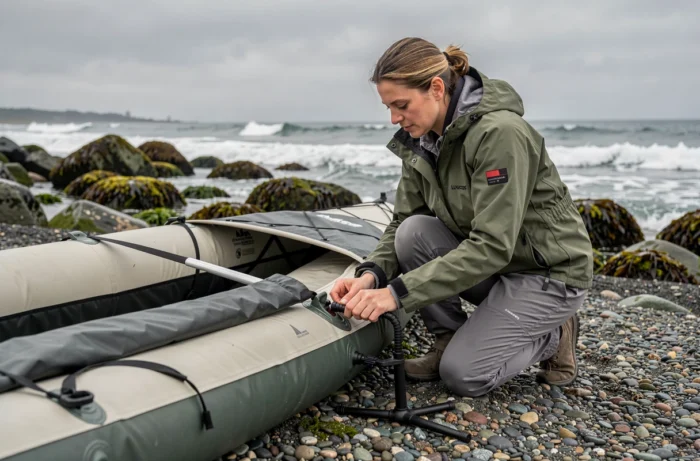
A high-pressure inflatable floor (dropstitch) radically changes the behavior of an inflatable canoe. This type of bottom, inflated to a pressure much higher than that of the side tubes, provides rigidity close to that of a rigid floor. For sea fishing, where the angler sometimes needs to stand to cast or maneuver equipment, a dropstitch floor is a prerequisite, not an option.
Lateral stability also depends on the width of the vessel. Models designed for the sea generally combine sufficient width to withstand chop without excessive rolling and a slightly V-shaped or semi-rigid hull to maintain a correct course against the wind. An inflatable that is too narrow will be fast but unstable with loaded fishing gear. A model that is too wide will become cumbersome to paddle over long distances.
The fin and tracking in marine conditions
The removable fin (or skeg system) is often underestimated. In rivers, its absence can be easily compensated. At sea, against lateral currents and wind, a deep directional fin significantly improves tracking. Ensure that the model offers a fin of at least twenty centimeters, ideally removable to facilitate launching from the beach.
Sea fishing layout: self-draining, attachments, and deck space
The marine environment imposes specific layouts that general-purpose inflatable canoes do not incorporate. Three elements distinguish a model truly suited for coastal fishing.
- Self-draining system (scupper holes): through-drainage holes evacuate water taken on by waves or spray. Without this device, the bottom of the canoe accumulates saltwater continuously, which degrades the equipment and destabilizes the vessel.
- Integrated or compatible rod holders: mounting rails, threaded inserts, or dedicated straps allow for securing rods during navigation. A simple deck elastic is not sufficient for sea rods, which are longer and heavier.
- Clear deck space behind the seat: the angler needs a flat accessible space to place a cooler, a tackle box, or a portable fish finder. Models with a rear deck cluttered with decorative straps or too-small nets limit the organization of the fishing station.
We observe that specialized manufacturers now offer modular accessory kits (clip-on rod holders, fish finder mounts, elevated seats) compatible with standard rails. This modularity allows for adapting the fishing station without drilling or gluing anything to the inflatable cover.
Coastal regulations and safety: what applies to a fishing inflatable
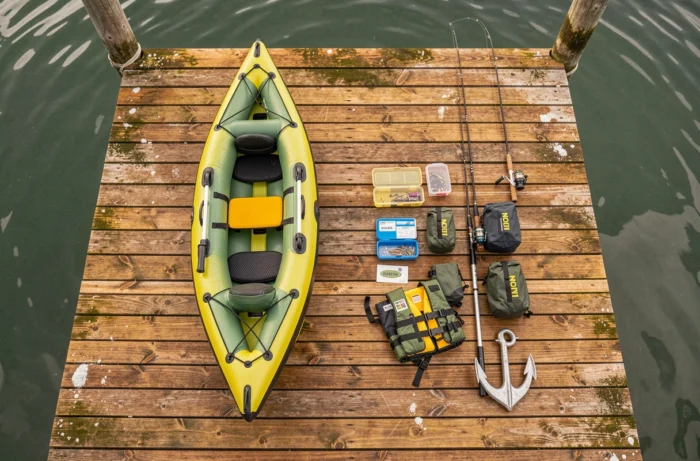
Navigating at sea with an inflatable canoe does not fall under the same framework as a freshwater outing. National regulations (division 240) set equipment obligations based on the distance from shelter. Within the 300-meter zone, an inflatable is generally classified as a beach craft, which eases the obligations. Beyond that, the requirements increase: life jacket, means of visual identification, sound signaling device.
A point rarely mentioned in buying guides: local municipal and prefectural orders may restrict the navigation of inflatables in certain coastal areas, especially during the summer or near swimming zones. Before investing, check the current orders at your usual spots with the harbor master’s office or the town hall.
Load capacity and safety margin
The load capacity announced by the manufacturer corresponds to the maximum theoretical load. In marine conditions, with chop and current, we recommend not exceeding two-thirds of this capacity. Angler, fishing gear, safety equipment, cooler: the total easily exceeds what one might imagine. An overloaded inflatable at sea loses its stability and maneuverability, two factors directly related to safety.
The choice of an inflatable canoe for sea fishing rests on a limited number of decisive criteria: material quality against salt and UV, high-pressure floor for stability, deck layouts suitable for the activity, and locally verified regulatory compliance. A model that ticks these four boxes will provide reliable outings over several seasons, provided that rinsing and proper storage are maintained.