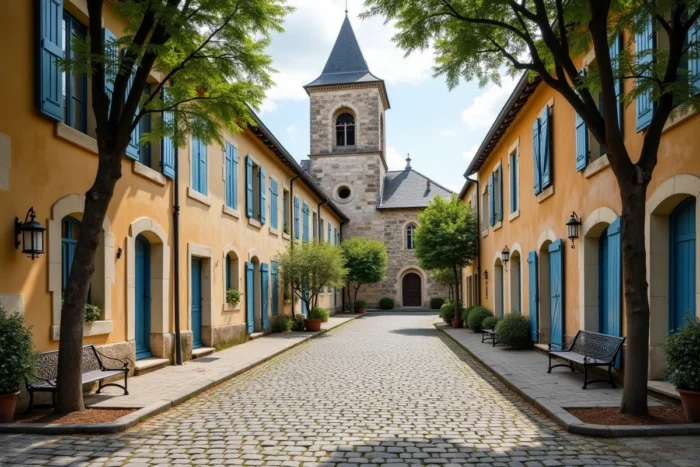
The Val Bréon refers both to a territory in Seine-et-Marne and an economic activity zone that shapes the life of several rural municipalities southeast of Paris. This name frequently comes up in local debates, between development projects and the protection of agricultural land. Understanding this territory means grasping the tensions that many suburban municipalities in Île-de-France are experiencing today.
Soil Artificialization and the Val Bréon 2 Project: The Controversial Issue for the Territory
You may have heard about logistics zones encroaching on fields in the greater Paris area. The Val Bréon precisely illustrates this phenomenon. The ZAC of Val Bréon, located along the RN4, initially attracted warehouses and commercial activities due to its position between Paris and Brie.
The problem arose with the so-called “Val Bréon 2” project. The Val Briard community of municipalities acquired about 150 hectares of agricultural land in the municipalities of Châtres, Les Chapelles-Bourbon, and Marles-en-Brie, for a total of 17,250,000 euros. The goal: to expand the existing activity zone.
The FNE Seine-et-Marne association pointed out an inconsistency. These lands are marked as “yellow dots” in the 2013 Île-de-France Regional Master Plan (SDRIF). In practical terms, their urbanization is conditional on the construction of an RER station, an infrastructure that is not included in any SNCF or Île-de-France Mobilités program.
In June 2021, several dozen local residents demonstrated in Les Chapelles-Bourbon, holding banners with the slogan “Save the agricultural lands of 77.” The consultation around the project was launched in 2019, but local acceptability remains a major sticking point. The debate goes beyond a simple opposition between economy and ecology: it raises questions about inter-municipal governance and the transparency of public spending in a rural territory.
Information related to this territory and its institutional life is gathered on https://www.valbreon.fr/, which serves as a useful entry point to follow the evolution of these issues.

Val Briard Community of Municipalities: Understanding Local Organization
The Val Bréon has not been an autonomous intermunicipality since 2017. The former Val Bréon community of municipalities, created in January 1995 and based in La Houssaye-en-Brie, included 10 municipalities in Seine-et-Marne. It merged with the community of municipalities of Sources de l’Yerres, as well as with the municipalities of Courtomer and Favières.
The result of this merger is the Val Briard community of municipalities, which brings together 21 municipalities and about 30,000 inhabitants. It manages shared competencies for villages, most of which share a similar structure: an old town center surrounded by residential areas.
Two hubs stand out due to their size:
- Fontenay-Trésigny, with about 5,500 inhabitants, offers services such as a swimming pool, a gymnasium, and a middle school.
- Rozay-en-Brie has around 2,800 inhabitants and also provides essential facilities (cultural hall, high school).
- The other municipalities are more modest, often with populations below 2,000 inhabitants and an associative fabric that carries most of the social life.
This intermunicipal organization has a direct impact on planning decisions. It is the Val Briard community council that is driving the Val Bréon 2 project, which explains why residents of neighboring municipalities feel concerned without always feeling consulted.
Cultural Life in Val Briard: L’Envolée and Local Events
A territory is not just defined by its activity zones. Val Briard also offers a cultural program structured around L’Envolée, the artistic hub of Val Briard. This facility offers a schedule of shows and events, with appointments planned for 2026.
The richness of the Briard terroir also plays a role in local identity. The presence of local producers and farms feeds markets and seasonal events. This local economic fabric is precisely what opponents of Val Bréon 2 seek to preserve.
The rural heritage and landscapes of Brie constitute a factor of tourist attractiveness that the community of municipalities highlights. The proximity of attractions like Disneyland Paris or the Lumigny Safari Reserve generates a flow of visitors, some of whom discover the surrounding villages.
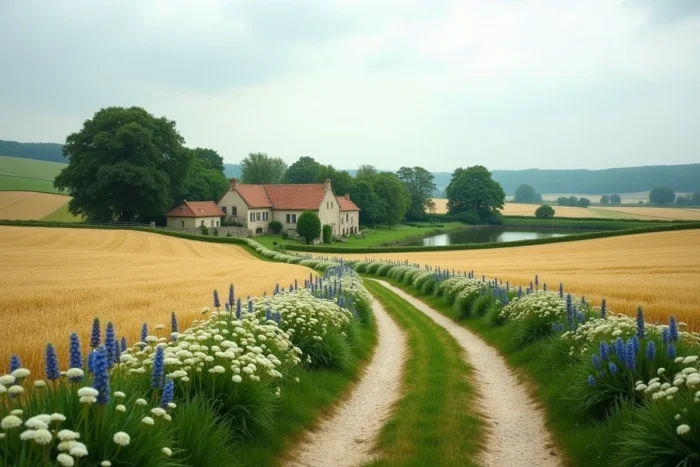
Economic Attractiveness and Ecological Limits: What Balance for the Municipalities of Val Bréon?
The underlying question is the compatibility between economic development and the preservation of a rural living environment. The ZAC of Val Bréon has generated jobs and tax revenues for municipalities that needed them. The Seine-et-Marne department remains predominantly rural, with municipal budgets often constrained.
The extension towards Val Bréon 2 relies on a gamble: that of replicating the logistics model on a larger scale. Supporters see it as a source of economic dynamism. Critics raise several concrete objections:
- The lack of rail service makes the project dependent on road transport, contradicting emission reduction goals.
- The artificialization of productive agricultural land reduces local food capacity and accelerates soil sealing.
- The SDRIF explicitly conditions urbanization on a non-existent RER station, which raises a regulatory compliance issue.
- The purchase price of the land, deemed high by associations, raises questions about inter-municipal financial management.
This type of tension is not unique to Val Bréon. Many suburban municipalities in Île-de-France face the same dilemma: accommodating economic activities to fund local public services while preserving the natural and agricultural spaces that underpin their quality of life.
The Val Bréon 2 file remains open. The outcome will depend as much on regional decisions as on local mobilization, in a context where the Climate and Resilience Law now imposes objectives for reducing net soil artificialization at the national level. For the residents of Val Briard, this is a topic that will continue to shape communal life in the coming years.